Deprecated: Function WP_Dependencies->add_data() was called with an argument that is deprecated since version 6.9.0! IE conditional comments are ignored by all supported browsers. in /home1/sourceme/public_html/veleda/wp-includes/functions.php on line 6131

Deprecated: Function WP_Dependencies->add_data() was called with an argument that is deprecated since version 6.9.0! IE conditional comments are ignored by all supported browsers. in /home1/sourceme/public_html/veleda/wp-includes/functions.php on line 6131

Suppressed Histories: what’s that?

Spiral pot, Ban Chiang culture, ancient Thailand

The richness and complexity of women’s history: the artist-philosophers who created magnificent scriptures of signs in neolithic ceramics, the python-oracles of southeast African rain shrines, the female clan heads of the Mosuo in Yunnan. Legends tell of women who invented agriculture, who founded peoples, cities, or religions. Rebel priestesses like Muhumusa in Uganda or Veleda in the Batavian uprising against Rome or the Tongva shaman Toypurina where Los Angeles now stands. Nonconformist poets like Walada bint-al-Mustakfi in Spain or Akka Mahadevi in south India: women who defied the rules of patriarchy and empire, courageous clan mothers, women who dared to love women, feminist and labor organizers, indigenous sovereignty activists, freethinkers and mystics.

Women's ceremony with serpents, eastern Iran, ca 2400 bce

We’re seeking out strategic knowledge, what Gloria Anzaldúa called conocimiento, “a little serpent for counter-knowledge.” History can empower — finally, after centuries and millenia of patriarchal and colonial manipulation to prop up power structures and burnish dynastic pedigrees. It contains what the powers-that-be never intended us to discover. “Subjugated knowledges,” in the words of Maori thinker Linda Smith. We are decoding the written record, pulling aside its systematic bias to see what patterns reveal themselves.

None of this means taking a romanticized or oversimplified view. We’ve been told for so long, countless times, that women are inferior, that men have always dominated, that whites are superior, that Africans are lesser, “underdeveloped,” lacking in “real” history; that aboriginal religions are invalid, their sciences insignificant, and their historical orature irrelevant. A shift in thinking is right and necessary, and in recent decades scholars have been running to catch up to the realities, the obscured achievements, and the chronologies that go back much further than the old “experts” thought. Now coming into wider view are the strengths of all those interlocking groups and categories, their achievements and beauties, in spite of the ways they’ve been oppressed and kept down.

Makiritare Lodge, upper Orinoco River, Venezuela

Reweave the connections: map the pre-conquest American Indian countries (yes, countries, think about that) and the vast tracts of Asia that are left out of history texts. The gender-egalitarian matrilineages of the Vietnam highlands and Cambodian lowlands, with their longhouses and female courtship customs. The African chronologies, religons, and archaeology; the syllabaries of Ethiopia and Meroë, Vai and Malinke; the architecture of the Sahel and Old Zimbabwe; the impressive female megaliths of Ethiopia which are missing from virtually all books on African history, archaeology, or art.

Monumental woman, Gora Shino, Soddo region of south Ethiopia

Take into account the sea links across the Indian Ocean, and across the Pacific, bringing Asian chickens to Chile in the 1300s. (See “Radiocarbon and DNA Evidence for Pre-Colombian Introduction of Polynesian Chickens to Chile,” 2007.) Bring forward connections that only archaeological specialists know about, like those between Ecuador and western Mexico. Know that the Chumash plank canoes have Pacific Island prototypes, and are called by a name derived from Polynesian languages. (“Diffusionism Reconsidered: Linguistic and Archaelogical Evidence for Prehistoric Polynesian Contact with Southern California,” 2005.)

DNA researchers of human origins and migrations are now talking about “cryptic population histories.” One of the oldest is the first African diaspora, over 50,000 years ago, whose short-statured Black descendants are scattered from Oman to southern Thailand to the Philippines, and across various Indonesian and Melanesian islands. Linguistic keys point to ancient kindreds between Florida and Veracruz, between North and South American peoples. So much we are only beginning to learn—and what will the aboriginal histories add to all this? They are so rich in female founders, in truly democratic polities and spiritual philosophies.

One of the stone Adena Tablets, ancient Ohio

So we reconfigure to an international perspective, toward chronologies not generated by empire-builders, but revealed in a dawning awareness of Brazilian earthworks and canals, East African and Pilipino land-terracing; megalithic statues of Sumatra and Sulawesi, France and Portugal, Ethiopia and Colombia; Mississippian mound temples, trade networks, and inscribed tablets, Moroccan stone circles, and those really ancient connections between the Saharan river peoples and the Khartoum neolithic. The breathtaking ceramics, so many millenia ago, of Moravia (Czech Republic), of the Amur river valley in Manchuria, of medieval Arkansas and Tennessee, New Mexico and Arizona.

Isis terracotta from Fayyum, Ptolemaic Egypt

This kind of history takes into account the great religious movement of Isis veneration, that spread from Egypt to Sudan and across the Mediterranean to Lebanon, Greece, Italy, Tunisia, Sardinia, Spain; to Britain, Germany, Hungary, and from Syria and Iraq unto Kazakhstan. This transnational religion overcame Roman state persecution, was a major competitor of early Christianity, and made its last stand on the sands of Nubia, when the Beja fought Byzantine armies sent to crush all other religions than the one decreed by latter-day Roman emperors.

What happened in Europe? patriarchy, yes, empire and feudalism. But also the internal colonization of its ethnic cultures, destroying aboriginal ways, suppression of the priestess, shaman, diviner, of the drum, sweatlodge, sacramental dance. The totalitarian union of church and state, begun under the late Roman empire, expanded across the continent over centuries. Judicial torture was adopted from Roman law, and used to inculcate diabolist ideology (“Diana is the devil,” and all other non-Christian deities got the same treatment). This spilled out far-reaching effects on cultural attitudes toward women, sexuality, peoples of color, and non-christians, from Jews and Romany to Indigenous peoples in the path of European empire. Even after centuries of witch hunts, some local, marginalized cultures managed to preserve some of the ancient traditions. The long-reviled and devalued female powers are now being recovered and restored.

If we can name something, it becomes possible. The medieval Spanish spoke of convivencia: the ability of different cultures to live together. They succeeded rather well, for a time, producing a blend of Iberian and Moorish and Visigothic culture, of Catholic, Muslim and Jew, with a old Pagan admixture. Then the Reconquista polarized all these identities, and the Spanish Inquisition arose with along with the racist code of limpieza de sangre (“purity of blood”). They propelled expulsions of Jews and Moors, forced hundreds of thousands to convert, and persecuted their descendants with fire and iron, locking down the peninsula and its colonies for centuries.

We need to understand patterns of social control. Totalitarian doctrines brook no questioning, no challenges, driven by what

Witch's Chair, a heated-iron torture used in German witch trials

Diana Eck calls “imperial certainty.” We can also name this “patriarchal absolutism,” with women only as a backdrop, invisible sustainers with duties but few rights, in ranked societies that put property before people, and enforce domination with violence, open and covert. Humans caught in these systems must step carefully, negotiating under pressure for even small shifts in constrained circumstances.

Time to stop looking past the crushing confinement of females in so many societies: “For after obedience, poverty, and pure chastity, you have holy enclosure to hold on to, enclosure in which you can live for forty years either more or less, and in which you will die. You are, therefore, already now in your sepulchre of stone, that is, your vowed enclosure.” –Testament of Saint Colette (addresssed to early modern Italian nuns) Or the Afghan Shi’a jurists’ pronouncement in 2009 that women had two rights: to obey their husbands and to pray, but not in the mosques. The repression of women as women would fill books: too many instances to list now, but you can read more here.

To talk about patriarchies means confronting a powerful social taboo charged with tremendous amounts of fear, anger and denial. These systems of domination are based on violence and pervasive coercion which are, literally, unspeakable. In my lifetime I’ve watched women rise to courageously name the injustices, and also witnessed a falling away in times of backlash, divisions, diversions and dissimulations. It’s crucial for us to undo the cultural spells that decree who women must be. They have seduced so many into settling for the false, subordinated identities peddled by the consumerist mass media spectacles. The real spectrum of female humanity is far greater, full of valor, creativity,  inventiveness, daring, and generosity.

Silencing is fully active for the dire realities of genocide, colonization, and destruction of culture. Not just in a willfully-forgotten history that

Sarah James, defender of Gwich'in caribou lands from oil companies

talks about “vanishing” peoples, but in the ongoing Now of land seizure, logged forests, dams, poisoned watersheds, toxic mines and oil-drilling; of indigenous refugees forced into urban slums, where they join other peoples trapped in the racial caste system that is the legacy of enslavement, conquest, and empire. Many of them make long journeys in a desperate struggle to survive, and become peons-without-papers laboring in the industrial farms that feed the empire. The  corporate maw chews up workers to feed the voracious mass-market of manufactured desire, and  tosses them away when their bodies are broken, or in order to relocate to countries where labor is even cheaper, places with regimented factories whose workers are housed in barracks. And the women working for bare-survival wages in these places raped, sexually harassed, stalked as they make their way home, and sometimes murdered, like the maquiladora workers in the femicide capital of the borderlands, Juárez. In the US territory of Saipan,  companies tied to anti-abortion extremists back in the USA even force women workers to have abortions. (It’s true: search for “forced mandatory abortions” on this page.)

We need to understand that overturning these structures of domination is an act of love. That they go to the very heart of the disorder, which now endangers human survival and the world itself. The Big-Man hierarchy of force, exploitation and accumulation has allowed the worst to take charge (or to force the hand of those who know better). Look where it’s gotten us.

Time to move away from maladaptive fixations and refocus on what is good, what will help. Divide and conquer has stopped people from understanding how the systems of domination intertwine. Playing off one liberation against others has created conflict, what Rachel Bagby called “ism schisms,” and has prevented solutions. There are other options, other ways to live. That’s not “utopianism,” it’s the historical reality.

Max Dashu
A non-definition of “shaman”

Max Dashú

It’s difficult to define “shaman,” because it is culturally variable in so many ways, but we need a basic general description. I see “shaman” as belonging to a continuum of many names and roles: medicine woman, oracle, prophetess, diviner, dreamer; priestess, raindancer, communicant with ancestors, deities, Nature spirits; trance-dancer, shapeshifter, spirit-rider, cosmonaut. Countless descriptions show ancient priestesses engaging ecstatic incantation, sacred dance, and entranced states. Thus the Cappadocian priestesses of an Anatolian goddess fire-walked across burning coals without being burned. Thus the temple dancers of ancient Egypt with their sistra and hand-drums, the

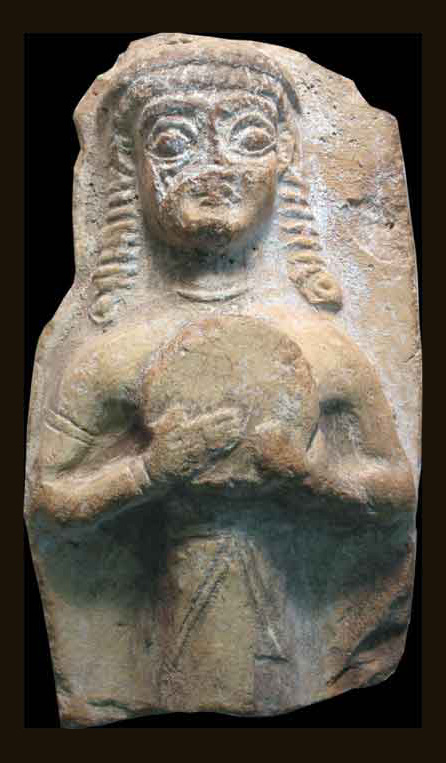
Syrian priestess with drum

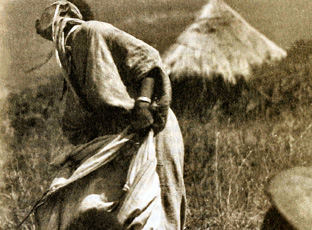
devadasis of India, the Canaanite qadeshot, the Peruvian priestesses who are depicted dancing and drumming. The rain shrine priestesses of Malawi with their python spirits and sacred pools were shamans by any definition of the term.

This shamanic background is why “priestess” calls up ecstatic associations that authoritarian religions regard as illicit and even demonic, and why so many of these religions excluded women from priesthood. Some went so far as to bar women from the altar, from temples or their inner sanctuaries, or from other shrines. The patriarchal lens has also twisted interpretation of sacramental dance and entranced spirit mediums, claiming that they exhibit the “natural,” allegedly “passive” province of women (and queers, and colonized peoples, and other Others). Most notoriously, these doctrines have recast European witches in the mold of magical evildoers—although as late as the 1400s the British were referring to a prophetic woman as The Witch of Eye (an English town).

Spinning witch with magic wands, Scandinavia, from Olaus Magnus, The Northern Peoples, 1555

Shamanism is a subject pervaded by political ramifications, because it represents direct spiritual power, energy that can not be controlled by man-made hierarchies or ranked social systems. It represents contact with Chaos in its original sense of the primordial Vastness, as well as its quite recent scientific sense of quantum physics and meteorology. Shamans connect with the core of being, the whole of beingness, the Source of wisdom and transformative power. This represents a threat to oppressive social orders which set certain classes of people (men, whites, dominant classes, settlers, heterosexuals) over Others. Shamanic cosmologies and ceremonies are also considered a threat, because they emphasize relatedness and delve into the ineffable, timeless, vast cycles of creation and destruction.

Pawnee Ghost Dance robe

No hegemony can withstand that primal power, and so there is a long history of repression. It accounts for the U.S. outlawing and persecuting American Indian religions and why, having militarily defeated the Plains Indians, it was so threatened by the Ghost Dance. Why Chinese mandarins destroyed shrines of the Wu; why European men, with all their laws oppressing women, still feared the witches; and why they feared African Santería, Lucumí, Vodou and Candomblé, and banned the drum in the U.S. slave states. All these categories of shamanic culture, sacramental dance, altered states of consciousness, continue to be feared, demonized — and attacked.

Turkic kam near Tomsk, Altai region

I describe a shaman as someone who receives a calling to commune with spirit / deities / ancestors, who enters ecstatic, unified consciousness. This may come spontaneously or at will by drumming, rattling, chanting, dancing or rhythmic breathing and movements; by singing power songs revealed in visions, dreams or other portal experiences; by fasting, going into wilderness or to other sacred places, calling, crying, and singing; and sometimes, by consuming sacred mushrooms or other sacred plants, such as the daturas and other (often poisonous) herbs.

The shaman often undergoes an initiatory illness, a near-death experience, an attack by a tiger or bear, or other traumatic event that becomes a gateway to transformation. These events act as a trigger for transformation, as the shaman breaks through and overcomes.  Often this experience is described as being consumed or dismembered or boiled, after which she is reconstituted and reconfigured as a shaman, sometimes with a new bone, crystal or other powerful object inserted into her body. Or she experiences a spontaneous breakthrough in which vision and power flood through her, a direct selection by Spirit (which usually cannot be refused).

Mazatec curandera María Sabina, Oaxaca

During her initiatory process, the shaman learns to access profound and exalted states of consciousness. Her spirits, deities, orishas, and very commonly, a shaman-ancestor, teach her through dreams, lucid visions, omens and energetically-charged experiences. She also frequently learns from other shamans in the community, being formally or informally trained by them, sometimes for years. This spiritual and ceremonial education often follows a recognized series of spirit sickness, signs or dreams. There is often a formal initiation, or the shaman may simply begin to gain recognition from the community based on her practice.

Counter to the modern market-driven shaman-fad, the shaman is chosen by the spirits, not self-selected. Initiation cannot be purchased, and boasting is a sure sign of pretense. Instead of self-indulgence and ego-boosting, the medicine woman puts in intensive effort, sacrifice, hardship, and suffering. This is true of any gender. I’ll never forget a video where Credo Mutwa explained to a rather conceited white guy that Zulu people do not seek out this path voluntarily, because they know how difficult it is, and that it involves sacrifice. This principle is alien to marketplace shamanism. Service to the community is part of the picture, though solitariness is paradoxically common too.

The classic Siberian shaman “rides” her drum or staff (often called a “horse”) into deep consciousness. She ascends the World Pillar or Tree which connects all the planes of the upper, middle, and lower worlds, and is able to travel through all the worlds. This idea of the shamanic pillar as a road of spirits is widespread, from the Peach Tree of Immortality in the mountain garden of Xi Wangmu in China to the central pillar of the Haitian vodou sanctuary, along which the loas descend and ascend. Countless other examples exist. These journeys are also described as flight, sometimes on the back of animal helpers, or as riding a spirit boat.

The shaman often paints the drumhead with images of her spirit helpers, her personal visions and power symbols. These drum paintings can be cosmic maps with the directions, the realms of humans and spirits, the various planes (often three) figured upon them. Like all sacred objects, these drums are consecrated, and in some places their spirits are fed with offerings.

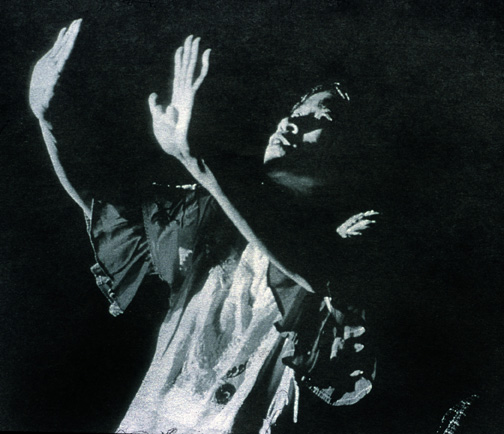
Ecstatic dance, zar religion, Ethiopia

In other traditions, the spirit-journey-inducing instrument can be the rattle,  shekere/calabash, clapping sticks, stamping tubes, or sounding the voice alone. This is accompanied by rhythmic movement, trembling, shaking the limbs, rubbing, whirling; rhythmic chanting or breath-huffing with sustained concentration. All this involves vibration, breath, dance. Shamans also carry out a diverse spectrum of ritual acts: washing, anointing with sacred substances (red ochre, white clay, pollen, turmeric, essential oils or fats), touching and brushing and sweeping with stones, eggs, herb bundles, burning of leaves, resins or other incense, or consuming stimulating substances (such as ginger in Indonesia and the Southern Pacific) or entheogenic plants.

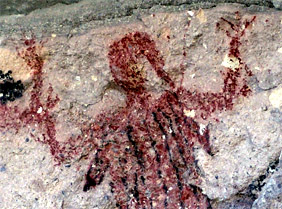
Invoking woman, rock mural in Baja California

It all boils down to praying with the body, through the body, in order to deepen and unify consciousness. In medical terms we could say that sacred dance, chanting, and drumming  activates all parts of the brain, entrains with the heartbeat, oxygenates the blood, and affects hormonal secretions. But all this describes only the physiological aspect of what is happening on multiple levels.

What shamanism does, in my view, is align body and soul, mind and spirit, into a state of full awakened consciousness. The shaman is healed by coming into awareness of old traumas, of stuck and trapped energies, and learning to release them. She washes them away, often literally by immersion in living water (this is the Hebrew wisdom of the mikveh, before patriarchal laws of uncleanness entered in). A modern Japanese prophetess who underwent a sudden revelation spent the next fifteen days pouring cold water over her head. (This repeated immersion in often-cold water has older precedents in Japan.) Modern industrial thinking regards these as acts of madness, but for someone undergoing a kundalini surge, they are an eminently sane response, and a liberatory process of clearing and awakening.

Hatsuhana Prays Under a Waterfall (1842) depicting a woman who attained miraculous healing power.

The elements enter in, not only symbolically as body/soul/mind/spirit, but actually, as earth, water, air and fire (plus ether, in some cosmologies). The elements have transformative powers, in the hot steam of the sweat bath, the cool paste of sandalwood on the skin, fanning with feathers or leaf-bunches, or by extended gazing into fire (or clouds, rivers, wind in the trees). Entering into this wisdom-awareness, what the Haudenosaunee call the One Good Mind, leads to understanding the language of birds, of animals and plants, the essence of stones. It is Nature-based wisdom.

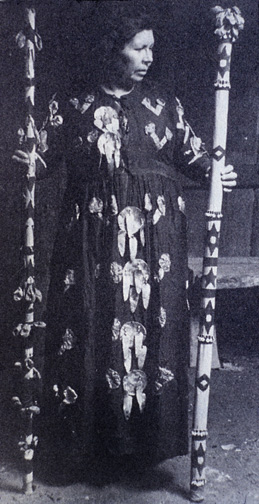
The great Pomo Dreamer Essie Parrish

This is just a really the broadest of summaries. There’s so much more: consecration, spiritual philosophies, the spirit-names and arcane languages, sacred tools and regalia, flight, animal doubles or allies. Watch this film Pomo Shaman (it streams online* from the link) which gives far more understanding than any description. It’s about the Kashaya Pomo Dreamer Essie Parrish, who was also known by the title Yomta (“Song”), recognizing her as a wisdom-bearer. In this 1953 recording, she tells us about her medicine in her own words, and shows us its pure, sacred essence.

Copyright 2010 Max Dashu

*Mac users: you need Windows Media Player to run this. Search for Flip4Mac for your OS and download, that should enable you to see Pomo Shaman. It’s worth the trouble, one of the most moving films I’ve ever seen.

Now fundraising for a new movie, Woman Shaman: The Ancients. Learn more, see the trailer and contribute here: