Deprecated: Function WP_Dependencies->add_data() was called with an argument that is deprecated since version 6.9.0! IE conditional comments are ignored by all supported browsers. in /home1/sourceme/public_html/veleda/wp-includes/functions.php on line 6131
Deprecated: Function WP_Dependencies->add_data() was called with an argument that is deprecated since version 6.9.0! IE conditional comments are ignored by all supported browsers. in /home1/sourceme/public_html/veleda/wp-includes/functions.php on line 6131
Not a book review, since I haven’t read the whole book, but here is some interesting information about women’s ritual and Divine Mothers in lower Congo from: Phyllis Martin, Catholic Women of Congo-Brazzaville: Mothers and Sisters in Troubled Times. Indiana University Press, 2009.
Martin has turned up some important testimony about women’s traditional medicine and ceremony in western Congo. Nganga (plural banganga) is a very widespread name in Bantu languages, from the Atlantic to the Indian Ocean to the Cape, for a medicine person (of whatever sex), diviner, “spirit medium,” shaman. To induce conception and protect her through pregnancy and birth, a woman consulted a nganga skilled in these matters.
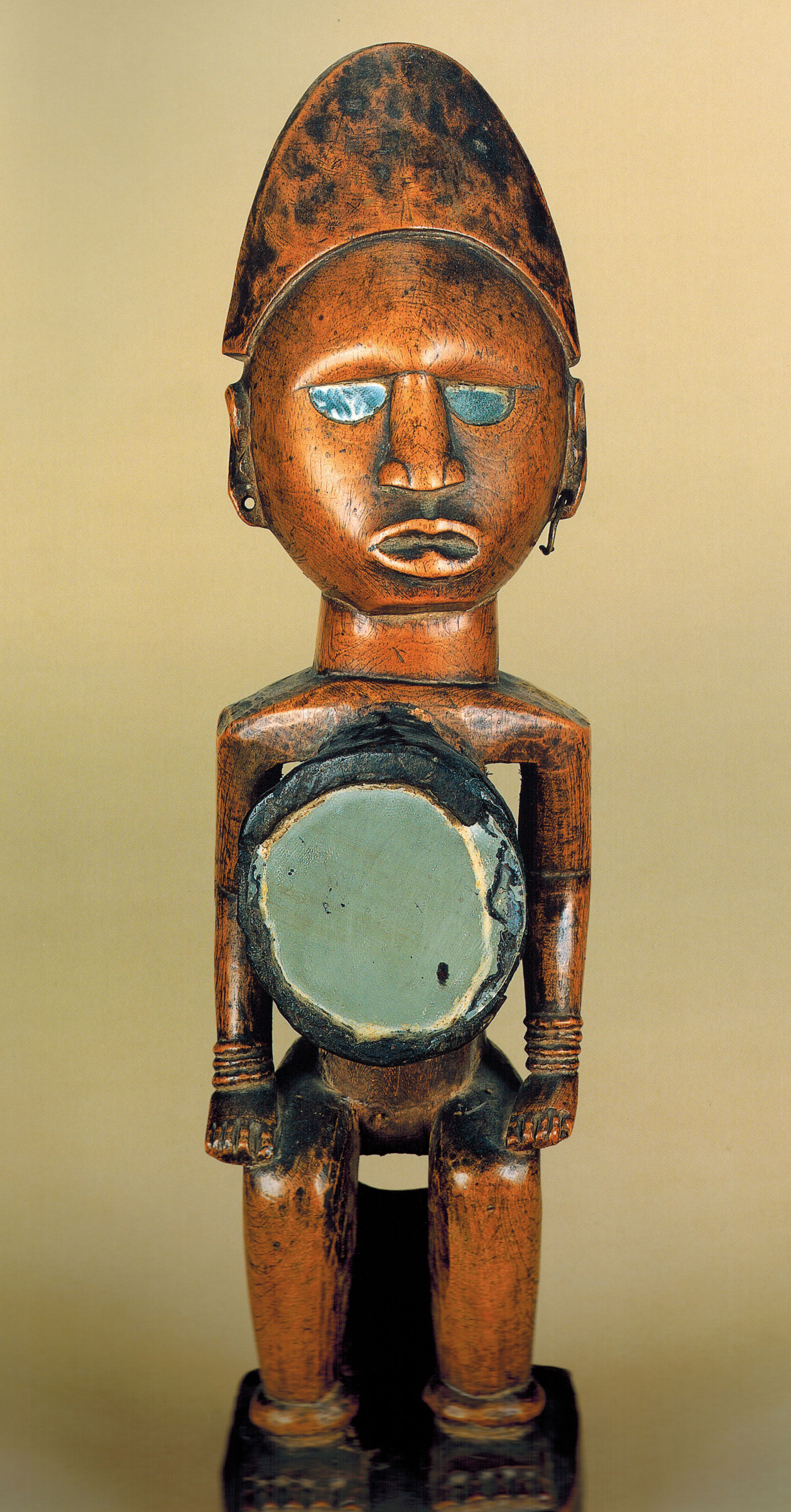
Nkisi with divinatory mirror, Congo
The nganga worked with minkisi (singular nkisi), ancestral beings whose power had been ritually embedded in a carved image. These ritualists were known as nganga nkisi. Some of them were guardians of minkisi in sacred groves. [24] German accounts around 1860-80 describe female nganga in shrines who dealt with female reproductive health and problems. Pechuël-Loesche tells of a Loango shrine for women and girls only, with armed protection guarding its perimeters: “Within it, the fetish* used by women from Lubu resided, healed and prophesied.” [See note below on “fetish” and cultural distortions.]
The statue showed a woman holding her breasts in her hands, in a style repeated in “innumerable small reproductions” used by women. “Mkissi [Nkisi] Mpemba was a gynecologist whose consulting days were associated with the waxing moon. In the second half of the month, at the time of the waning moon, it [sic] rested and gathered new strength.” The shrine was closed during the dark of the moon. [29-30]
Mpemba’s power was exceedingly great. Its fame reached to all territories. It had a large throng of women and girls who supposedly came to it even from the forest country [the Mayombe region] and even further in the interior…. Mpembe’s robe played the main role in the gynecological treatment in the fetish hut [sic], and besides that, a plank led down a slope through a hatch… Whatever else happened inside the fetish remains a mystery. For only girls and women who wanted a good husband, who wanted to be free of sufferings, who yearned for the joys of motherhood, who wished happily to survive their moment of giving birth, were allowed inside. [in Martin, 28]
Martin then lays out a shift that happened in the colonial era, when men began to see this shrine as a threat and destroyed it. There are several accounts of how this happened. One says that men from Loangili “had attacked the shrine and stolen, burned, or carried off nkisi Mpemba, or dropped it into a deep crevice during a moonless night. [Or, according to another local source]… “the men of Lubu are said to have committed the bad deed because the profitable activity and the increased power of the village women had become alarming to them.” This happened before 1870. Women were forced to abandon their ruined sanctuary but were rumored to continue holding ceremonies in secret.
Another women’s shrine, Mbinda of Buluango, rose to prominence with the destruction of Nkisi Mpembe sanctuary. The nkisi lived in a palm grove. Women who came for treatment abstained from men, hair care, tobacco, liquor and water. Mbinda too came under attack, the nkisi captured and thrown into the ocean. But her devotees rescued and reconsecrated her. Women flocked to these shrines in the Mayombe area and deep inland. [29]
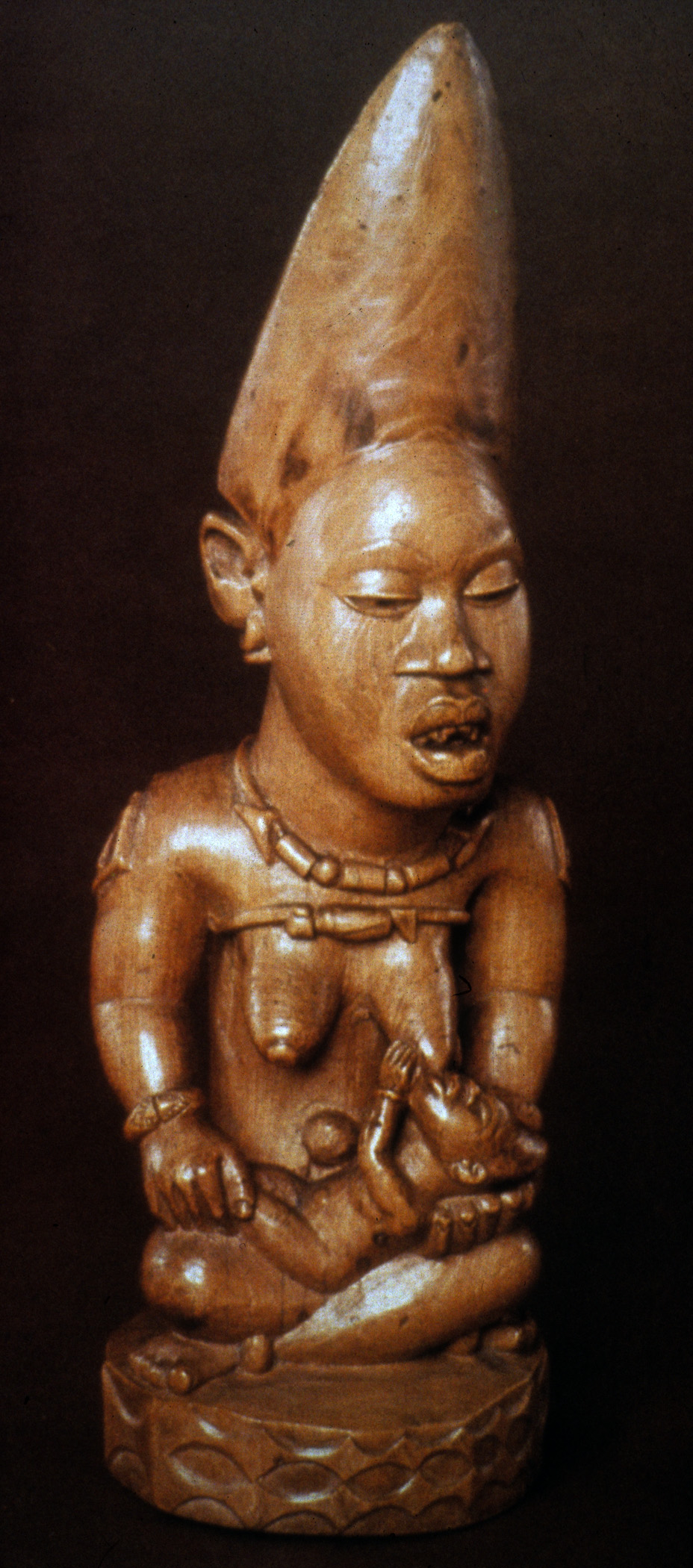
The BaKongo are well known for the pfemba, their wooden sculptures of a seated mother with a child. Over 600
Pfemba of black ivory, Kongo
pfemba are known. They show the Mothers as icons of beauty and fruitfulness, tattooed, adorned with jewelry, and crowned with high coiffures or “prestige caps worn by authority figures in Kongo society.” They were anointed with red tukula paste, signifying “transformation and movement between different worlds, as in initiation and childbirth.” Some are inlaid with mirrors. Although it is common to see stereotypical descriptions about “fertility figures,” Mary Nooter Roberts writes that the pfemba “are one of the rare instances in African art where the female image is created specifically to assist with fertility.” [in Martin, 25]
Martin describes the wide popularity of small mother-child icons after the fall of the women’s shrines. Pfemba figures appear on tombs, doorposts and staffs of chiefs, household shrines, and musical instruments. “The French anthropologist Albert Doutreloux confirmed the high respect in which women were held, the genealogical knowledge that they guarded, the magical powers for which some were feared, and the kind of pressures they could exert in village discussions, including leadership roles when men were absent.” They spoke in public assemblies and had influence in lemba associations. However, the devastation of the slave trade, colonialism, and the rise of a merchant class undermined these traditions. [29-30]
This decline of female authority, and of old indigenous cultural patterns. is reflected in the loss of power of the Makunda. She was a leading royal official who was most often the sister or wife of the Maloango:
In the seventeenth century, she had great power, seeing to the interests of women, advising the ruler, and sometimes taking over the interests of the ruling clan during an interregnum. Her main function, however, was ‘to represent all mothers, who were the propagators of the tribe, who bore all the burden and worriment of procreation.’ Anyone could go to her court and ask for her justice, but she was particularly sought out by women and girls who had complaints against men. By the late nineteenth century, this power was gone…
Only a trace of it remained, as Pechuël-Loesche wrote, “practiced on a small scale by princesses with land, as far as their power is recognized at all.” Martin points out that women still had economic power through farming and trade, but their hard work did not bring wealth. She refers to matrilineality among the Yombe, but this too was now being leveraged for the political advancement of men. “Women were also centrally involved in the most powerful therapeutic association in lower Congo.” This was the lemba association. As Martin describes it, lemba was driven by traders, chiefs, and powerful men, (who were much concerned to suppress any witchcraft directed towards their wealth), but gradually lemba specialists moved more to pregnancy and childbirth. (I have to wonder if this was not the original focus suborned by the political developments referred to earlier.) [30,23]
*A note on “fetish”: this word has an objectionable history and connotation. I include the quote using it because it offers other valuable information. On nkisi, Martin refers to a comment that “no corresponding institution exists in European culture.” So the Portuguese word feitiçao (“sorcery” or “sorcery object”) was applied instead to these central African sacraments, carrying along with it all the cultural assumptions of European diabolism and witch persecutions. When you read about nails being driven into a “fetish” (the anglicized form), most often they are talking about a nkisi.
The minkisi came into play in slavery times, as a way to fight back against slaveholders (who feared them) in Brazil, Haiti, and Congo itself. [Some examples are given by one of Martin’s cited sources, Wyatt MacGaffey, Kongo political culture: the conceptual challenge of the particular. Indiana University Press, 2000. But much more documentation on this has been done by Africana scholars.]
The Goddess on a Lion Throne is abundantly attested in the archaeology of Lebanon, Syria, Jordan, and Canaan/Israel. First we’ll look at some Phoenician scarabs showing lion thrones, often winged. Then, actual stone thrones from ancient Lebanon, Canaanite ivories with the winged sphinxes, and an alabaster effigy of ‘Ashtart enthroned with winged lionesses. This leads to commentary on some strong biblical parallels. And we’ll look at some late hellenized forms of the Anatolian Lion-Throned Goddess.
SCARABS
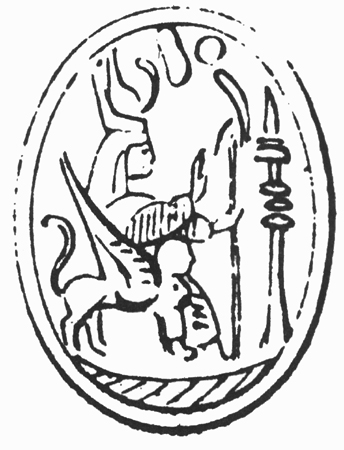
Phoenician scarab
Goddess offers benediction to a supplicant, under a winged sun and the planet Venus.
Many of these Phoenician scarabs show a brazier for offering incense.
Scarab from Syracuse, Sicily
The many Phoenician finds in Sicily exhibit strong Egyptian influence. The Goddess wears the crown of Upper Egypt, with a very snaky uraeus, and holds a lotus sceptre, an attribute of Kemetic goddesses.
Goddess wearing the Kemetic crown of the Two Lands of Egypt
on a breasted-sphinx throne with was-sceptre and burning brazier.
Scarab from Sidon, Lebanon
Scarab from Sidon, Lebanon, with winged sun and the star of ‘Ashtart
(the planet Venus). The Goddess wears a headdress of Persian type.
THE THRONES
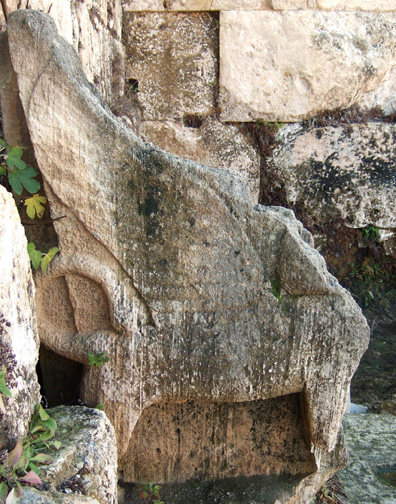
Throne of ‘Ashtart, in her Phoenician chapel inside the Eshmun temple,
Sidon, Lebanon.
The lion thrones in the scarabs depict actual thrones in Goddess temples. Besides this one, examples are known at ‘Ain Dara, near Aleppo, Syria; Dura Europos, on the Euphrates, Syria; and Khirbet et-Tannur, Jordan. Besides these, Inanna, Ishtar, and Kybele are depicted on lion thrones; while Isthtar, QDSU/Qadashah, ‘Ashtart, Asherah (in Tree form), Anahita, and the Hurrian goddess Hebat are among the goddesses shown standing on lions. (This is in no way an exhaustive list.)
Ashtart Throne, Khirbet et-Tayibeh, Tyre, 2nd century bce
Astarte Throne with Kemetic Sphinxes, Palmate Sign, and Two Betyls representing the Goddess and Her Consort. Betyls (from beth-el, house of the god) are sacred stones of a type found at Hazor nearly a millennium before. Countless earlier examples are found in the Levant and Arabia, and the Bible describes the raising of these matzeboth.
Phoenician throne with betyl, 4th to 1st bce
Phoenician throne with betyl and Tree of Life motif, Lebanon
This one has many similarities to the throne above, including the male sphinxes and
the Tree sign. See more examples of this association in the ivories below.
Throne from Beth Shean flanked by winged beings
A stone throne from Beth Shean in the West Bank, undated,
but much older than the foregoing examples.
THE IVORIES
Goddess thrones with lions or sphinxes have direct parallels in Canaanite ivories:
Ivory from Megiddo
The winged sphinxes also appear in ivory furniture ornaments of Canaanite and early Hebrew palaces. She appears to hold a Double Feather crown of Egypt. Note her multiple lioness breasts.
Samarian ivory from the time of Jezebel
This winged female sphinx may come from Ahab’s Palace of the Ivories; if so, this is where Jezebel lived. The princess of Tyre was renowned for bringing with her to Israel (she married Ahab) 400 priests of Baal and Asherah. Were there priestesses in this group? Hebrew, like Romance languages, uses the masculine default, and so the male plural obscures the presence of women in any group that includes a single male.
Egyptianate ivory from Samaria, circa 900 bce
This beautiful ivory shows the strong Egyptian gravitational field upon Canaan.
Egypt ruled the country for centuries, and artifacts from Canaanite temples are drenched
with Kemetic symbols and style. Horus sits upon a lotus, flanked by masculine winged beings
whose prototypes are Auset and Nebthet (Isis and Nepthys), long shown as winged protectors
in Kemetic art. Several Nimrud ivories, and earlier ones of Hazael of Damascus, show winged women.
Winged women, Nimrud ivories, circa 700 bce
The same motif on an ivory from Nimrud, Iraq, crafted by a Canaanite artist in Assyria. In the center would have been a sacred lotus-palm (like those on the Phoenician thrones above), of which only a bud and some volutes are now visible. (The pig-snout-like roundel at center would have held pegs that attached a palmate sign to the carving.)
Phoenician platter, circa 700 bce
The winged beings here flank the Tree of Life, a Goddess form. This is not speculation
(see next image, and recall the exampless from the thrones of ‘Ashtart above).
Further south, early Israelite iconography shows the goddess Asherah as this palmate Tree,
flanked by ibexes, and standing on a lion, just like Ishtar and Ashtart and Hebat.
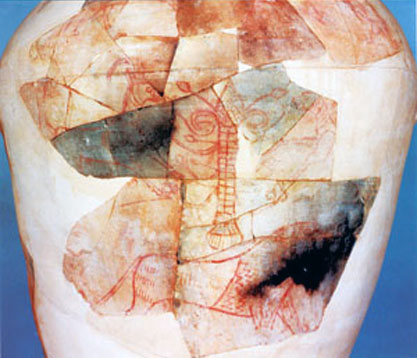
Asherah as Tree, pithos from Kuntillet 'Ajrud
The pithos from Kuntillet ‘Ajrud with the celebrated inscription
of “Yah of Teman and his Asherah.”
This discovery in the Sinai, along with another Asherah inscription at Khirbet el-Qom, finally broke through the long doctrinal insistence on Hebrew monotheism in the early kingdom period. The image combined with the inscription naming this goddess is quite powerful. Some scholars contend that the Asheratw of the inscription, and the asheroth/asherim of the Bible, allude only to a ritual pillar, not to the goddess. But since the pillar is named for the goddess and various prophets inveighed against both, this minimalist interpretation has little to recommend it, except to uphold the dogma that the Hebrews had nothing to do with any Goddess. And this claim conflicts with the testimony of Kings and Chronicles.
The archaeological record, too, shows overlap of Goddess/Tree flanked by rampant ibexes or goats. And more: the Lachish Ewer, found in a Canaanite temple circa 1500 bce, places a vulva in this central position. A goblet from the same sanctuary ties it all together even more dramatically with a menorah between the horned animals, and clinches the Goddess connection with an inscription that labels the goblet “an offering poured out to Elat.” As Joanna Stuckey points out, “the word for goddess, Elat, is positioned right over one of the stylized trees.” [See link above for more.] Descriptions of menorahs in the Bible leave no room for doubt that they represent the sacred Tree.
THE CHERUBIM AND THE MERCY SEAT
Now let’s look at this from another angle that relates directly to the Lion-Throned Goddess. We’ve seen goddesses depicted on the lion- or sphinx-flanked thrones; also represented by betyls on those thrones, and some empty thrones where the divine Presence is not depicted iconically. This last became the primary direction developed in monotheism, with its insistence on no direct representations of deity, now being understood in near-exclusively masculine terms. (There are a few references in the Hebrew Bible to godly motherhood.) Still, monotheism developed against a cultural background of preponderant Goddess iconography, and retained the archaic lion- or sphinx-throne. There are also some images of kings seated on such thrones: a stone relief of Ahiram and an incised ivory of an unnamed Canaanite ruler at Megiddo. But no gods on lion-thrones, only on thrones flanked by bulls, as discussed in previous posts.)
The Torah, however, continues to present the lion-throne as a divine seat, flanked by the cherubim. It describes them as winged guardians of the Holy of Holies in the desert Tabernacle of the ancient Hebrews:
And you shall make two cherubim of gold; of hammered work shall you make them, on the two ends of the mercy seat. Make one cherub on the one end, and one cherub on the other end; of one piece with the mercy seat shall you make the cherubim on its two ends. The cherubim shall spread out their wings above, overshadowing the mercy seat with their wings, their faces one to another; toward the mercy seat shall the faces of the cherubim be. And you shall put the mercy seat on top of the ark; and in the ark you shall put the testimony that I shall give you. [Exodus 25:18-21 (RSV)]
YHWH spoke from the space between these cherubim on the ark cover. This “mercy seat” was one and a half cubits wide (2.25 feet), the size of a throne seat. An additional ten cherubim figured on the Tabernacle’s curtains, and another on its inner Veil, making a total of twelve. [70]
Raphael Patai called attention to the feminine associations of the divine Presence in the Tabernacle in The Hebrew Goddess. It was described as a cloud hovering and filling the tent, “which at night glowed like fire.” He tells us that “the desert Sanctuary was called Tabernacle (Hebrew, mishkan: literally, ‘dwelling place’), because of the divine cloud that abode (shakhan) over it and in it.” [Patai, 73-4] These words come from the same root as Shekhinah, a word that became current as a name for the indwelling divine Essence in the Exile period. Along with Khochmah in Genesis and Proverbs, Shekhinah became a primary way of understanding the female aspect of divinity in Judaism.
In the Temple of Solomon, two gigantic cherubim stood over the ark. They were carved from olive wood and plated with gold, and were fifteen feet high, with a combined wing-span of thirty feet. The walls were covered with graven cherubim, palm trees and open flowers in gold. (I Kings 6:23-35). Before the destruction of the Second Temple in Jerusalem, Philo described the two Cherubim, who represent the hemispheres of heaven, with their wings “inclining to the mercy seat.” [Patai 76]
Cherubim was the plural of kerūv in Hebrew:ּרוּב, ּרוּבִים, which was latinized as cherubim. It had a special dual form kərūvāyim (a common form in Semitic, but as we’ve seen, these beings typically appeared in pairs). Hebrew keruv has cognates in other Semitic languages: Assyrian karabu, Akkadian kuribu, and Babylonian karabu. The Assyrian name means “great, mighty,” but the Akkadian and Babylonian forms mean “propitious, blessed”. They saw these beings as guardians of the Sacred. In Genesis, cherubim stood with revolving swords of flame at the East of Eden, “to keep the way of the tree of life.” [Gen. 3:24] So when I look at the ‘Ashtart of Galera, I see her, the female Divine in all her Glory, between the same winged guardians:
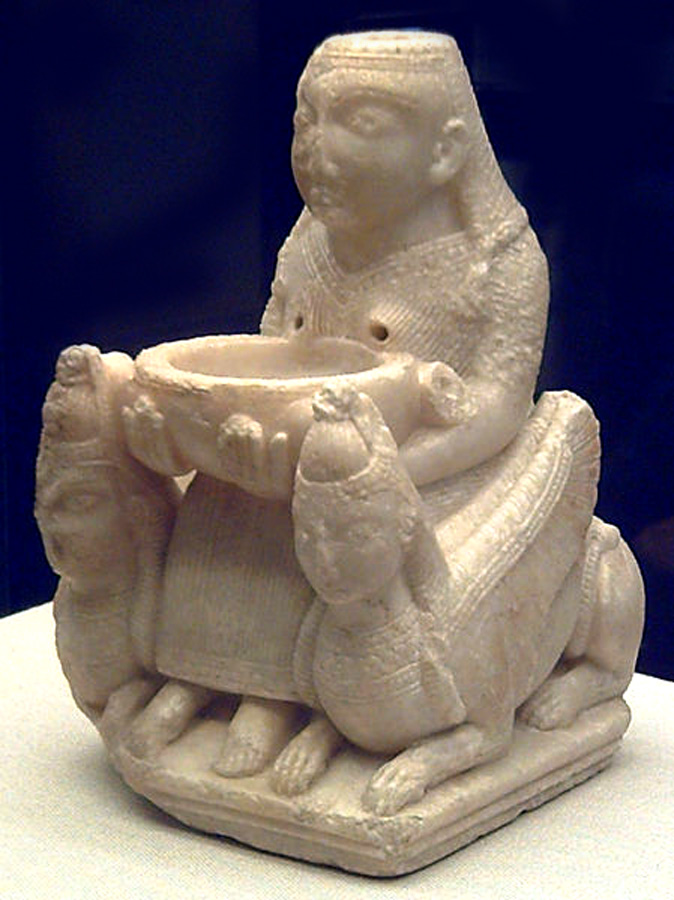
Lady of Galera, Tutugí, Granada, southern Spain
The ‘Ashtart of Galera, Granada, was placed in a Spanish burial circa 450 bce
but produced by Syrian or Lebanese artists near 200 years earlier. She is an alabaster vessel
designed for libation rituals; the liquid poured in through her head flowed out from her breasts
into the basin she holds. Some speculate that wax was placed in her nipples,
and the image heated, causing the liquid to suddenly pour forth.
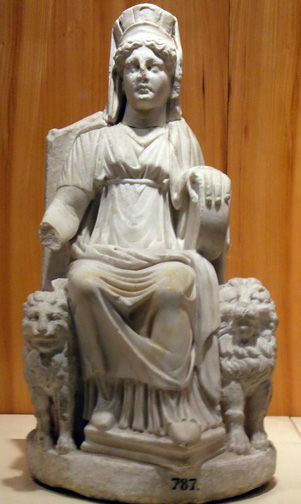
Kybele, Hellenistic era, Ashdod
A hellenistic Kybele from Ashdod, with her drum and
a mural crown borrowed from the Syrian goddess Tyche.
Mater Deum, "Mother of the Gods"
Kybele on a Roman coin, title Mater Deum, “Mother of the Gods.
She sits on the lion throne with sceptre and mural crown.
There are many more examples of this far-reaching pattern: the goddess shown between lions on the clay altar from Taanach; the lions of the famous Ishtar Gate in Babylon, and the many cylinder seals showing her standing or sitting on lions; the coins showing Atargatis of Hierapolis, Syria, and Juno Caelestis of Tunisia, riding on lions’ backs. I’m told that coins from Salamis, Cyprus, show Aphrodite standing on a lion or seated on a lion throne, in the 4th century bce.
Older than all of these are the lion-headed goddesses of Africa, most famously Sekhmet, in her profusion of monumental black basalt statues, and later the lion-faced goddess of Carthage, Tunisia. Older still is the Goddess of the Leopard Throne at Catal Höyük, circa 6000 bce. See my earlier photo essay on Cultural Continuites (with forms from Anatolia, Greece, Bulgaria, Lebanon, Rome, Spain, and Afghanistan) and my preceding articles on Goddess Temples in Western Asia, on this blog.
Continuing my photo essay and review of Kristina Michelle Wimber’s article
“Four Greco-Roman Temples of Fertility Goddesses: An Analysis of Architectural Tradition,” 2007.
Atargatis
Wimber compares the temples of Atargatis at Hierapolis and Dura Europos, Syria, with another on the Aegean island Delos, a Jordanian goddess temple at Khirbet et-Tannur, and the Derketo temple at Ashkelon. She remarks
Atargatis in her pillar aspect with ears of wheat. Syrian coin.
on the highly syncretic nature of this goddess, who blends old Iraqi themes with Syro-Palestinian and Hittite influences. [34] I would add that pillar goddess iconography from western Anatolia became especially influential. Atargatis is often shown in this form, closely resembling the statues of Upis/Artemis Ephesia, Hera of Samos, and others, on coins and in sculpture.
The best testimony about the Atargatis temple at Hierapolis comes from De Dea Syria, written by the Romano-Syrian Lucian of Samosata in the 2nd century ce. He says that Stratonice, wife of one of the Seleucid kings, had the temple built around 300 bce. (Legend claimed that the architect performed a self-castration to protect himself from accusations that might arise from showing his royal patroness around the construction site.) The great temple of Hierapolis stood on a hill surrounded by walls and was entered through a colossal stone portal with two tall columns beside it. [39-41] In front was a sacred lake with consecrated fish.
Atargatis of Hierapolis on her lion
In the usual Hellenistic fashion, Lucian interpreted the goddess through the lens of Hera, Aphrodite and Athena. The fact is that Atargatis did not really fit any Greek template. She was thoroughly Asiatic. (Wimber remarks, “In De Dea Syria Lucian can not even decide which deity Atargatis represents…”) [114] The divine image of Atargatis showed her seated on a lion throne next to her consort Hadad on a throne of bulls. Lucian wrote:
The sanctuary faces the sunrise…Within, the temple is not all of a piece, but contains another chamber. It too has a low staircase: it has no doors and is entirely open to the onlooker…In it are enthroned the cult statues, Hera [Atargatis] and the god, Zeus, who they call by a different name [Baal-Hadad]. Both are golden, both seated, though Hera is borne on lions, the other sits on bulls. [78]
Hebat on her lion, Tell Halaf (Bit Hiluli) Syria
This pairing is repeated at the sanctuaries of Dura Europos on the upper Euphrates and at Khirbet et-Tannur in Jordan. It relates to older temple iconography at ‘Ain Dara, which features the same goddess/lion and god/bull thrones, and at Tell Halaf, where Hebat stands on a lion and two gods on bulls.
Hierapolis (the “holy city”) was originally known as Manbug, from the Semitic root nb’ meaning “to come out”. The name is interpreted as a pouring forth of water from the rock. Devotees came to pour libations down a crevice in the rock under the temple, said to be the place where the Great Flood was swallowed up. This hilltop rock chasm points to a much older sanctuary that must have pre-existed long before the Seleucid temple was built. [39, 43] Its water ceremonies continued, with processions carrying the image of Atargatis to her sacred lake to be immersed, while others brought ocean water to the temple. [57]
The temple of Derketo at Ashkelon also had such a lake. The Greek physician Ctesias wrote down a story of how she turned into a fish after she leapt into the sacred pool. Lucian related that people here revered Atargatis as half woman, half fish, which is why they would never eat fish. He also refers to rites in which the statues of Atargatis and Hadad were carried to the lake to see the sacred fish. The name Derketo is a contraction of Atargatis. Little remains of her once-great temple now, of the organized demolitions under the Christianized emperors of late antiquity. (The coastal Palestinians resisted these temple destructions with determination, as Ramsey MacMullen documents, and even afterward refused to walk on the roads built with their stones.) But not all of the destruction happened then. Wimber turned up a traveler’s account of seeing a sculpture of a naked woman surrounded by fishtailed figures in the ruins of Ashkelon as late as 1697. [104]
Veneration of Atargatis spread throughout the Syrian diaspora, to the island of Delos, where Syrian merchants built a temple to the goddess in the 2nd century bce. It was laid out in the West Asian style, and had ties to the priesthood of Hierapolis. Other Syrians arrived on Delos, a major depot of the slave trade, as Roman captives to be sold. Large numbers of these enslaved Syrians were shipped off to the Roman plantations on Sicily. There they raised two powerful insurrections in the name of Dea Syria, led by prophets of Atargatis.
Atargatis with Hadad from Dura Europos, Syr
Coins from Hierapolis show Atargatis with lions. A relief from her temple at Dura Europos on the upper Euphrates shows her on a lion throne, with her consort Hadad beside her on a bull throne. Wimber comments, “This arrangement strongly parallels the cult statue at Hierapolis as described by Lucian—as does the lions flanking the throne at Delos.” [48] She goes on to draw other parallels:
One of the most important elements of Lucian’s account which the relief of Hadad and Atargatis found at Dura Europos corroborates is the standard with circles on it surmounted by a dove placed between the deities. It is called the semeion by Lucian and interpreted to be a symbol of the Babylonian queen Semiramis (c. 800 BC) who supposedly founded the temple in another of Lucian’s foundation myths. An interesting aspect of the cult revealed by the Dura relief is that Atargatis was apparently more important that Hadad because she is depicted as larger than Hadad and he appears pushed to the side and behind her. This belief is underscored by the inscriptions at Delos which mention Atargatis more often than her consort. [49]
Wimber also refers to “the relative importance of Asherah over Baal” in earlier Canaanite settings. However, I question her statement that “By the time of Lucian’s writings, Atargatis had lost many of the attributes of Ishtar including her blatantly aggressive sexuality and warlike character.” [38] We can not assume that these goddesses were identical, even though their names have a shared etymology. The first element in Atargatis is ‘Atar, an Aramaic form of the Semitic name for the planet Venus. (The second element has been identified as ‘Ate or ‘Atah, but its
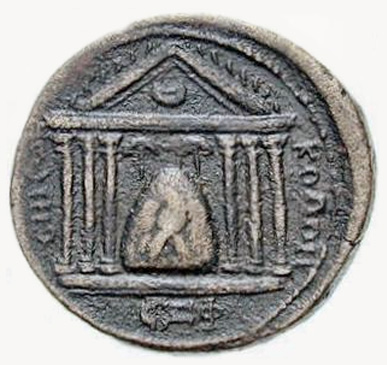
Stone deity in temple. Coin from Emesa, Syria
meaning remains unclear.) The name first turns up in the Annals of Ashurbanipal as Atar-Samain (Venus of the Heavens).
The linguistic constellation does reflect the co-gendered nature of Mesopotamian Ishtar, in the sense that some forms are female, such as Ashtart and Atargatis, while others are masculine: Yemenite ‘Athtar, Moabite ‘Ashtar, and Ethiopian ‘Astar. Even Ishtar is grammatically masculine in Akkadian, with the feminine form Ishtartu used in special contexts. In several places, these related deities were represented by betyls or standing stones. Ashtart-Aphrodite was revered at Paphos in the form of somewhat triangular pillars, for which precedents are found on the mainland, from Hazor to Arabia.
Nabataea: ancient Jordan and north Arabia
The old Nabataean tradition was veneration of betyl stone and niches cut into the rock. [50] This corresponds with two major Semitic traditions, the Hebrews of Jacob’s time, who raised matzeboth, and the Arabians up to the time of Muhammad, whose goddesses resided in standing stones. Their Phoenician cousins practiced this too; a marble pillar at Kition, Cyprus, was inscribed as a massebah to Astarte’s consort Eshmun. [90] Wimber says the Nabataeans spoke Aramaic (or at least their inscriptions were in that language, but that does not prove much, since Aramaic was the chancery language across west Asia in the last millennium bce).
Goddess with fish headdress, Khirbet et-Tannur, Jordan
The Nabataeans at Petra added Hellenistic sculptural icons, but in their own completely unique style, to the older aniconic stones. Al-Uzza, the goddess who represented the planet Venus and so corresponded to Ishtar /Ashtart /Inanna, appeared both as betyl and sculpture. Like Allat and Dushares, she was syncretized with the dominant Greco-Roman deities and sometimes called by their names. The influence of Atargatis is seen in the form of her sacred fish, which crown al-Uzza in a temple relief at nearby Khirbet et-Tannur. [50-1] Sea goddesses with fish are depicted in several Jordanian mosaics, with Greek inscriptions naming Tethys or Thalassa.
Although it can be difficult to find much about the goddesses of Petra—scholarly writings often concentrate on the god Dushares—Wimber fleshes out the picture considerably:
Al-Uzza was most likely the consort of Dushares while Allat was his mother, and perhaps the mother of all the gods. In certain cases Al-Uzza seems to have outstripped the importance of Dushares to the Nabataeans as she is often depicted as the larger of two betyls. Atargatis was not a
native Nabataean goddess and one inscription under an eye idol in the Wadi es-Siyyagh near Petra reveals that she was numbered among the foreign deities worshipped by the Nabataeans. … Nabataean religion remains a mystery and even the most notable scholars in the field cannot decide who exactly was worshipped where and what the attributes belong to which deities. [52]
While the original names are uncertain, Wimber concludes that the Nabataeans at Petra venerated al-Uzza, Allat, and Aphrodite in the Temple of the Winged Lions and, paired with a male consort, at Qasr al-Bint Pharaon (an Arab name that means “castle of Pharaoh’s daughter”). [75-6] I agree that the original deity names would have been Arabian, not Aramaean. Wimber compares the betyl-goddesses of Petra to the stone pillars of the old Hijazi goddesses, and cites Ibn al-Kalbi’s account of chopping down three trees in the sanctuary of Al-Uzza, and beheading the goddess on the orders of Muhammad. [92]
Khirbet et- Tannur
The temple of Al-Uzza here was built in the 2nd century bce, high on the hill Jebel Tannur and far from any city. [53] The temple faced east. It began as a sculptured altar, which kept growing larger, eventually reaching a height of over 10 feet. Old offerings were incorporated inside its new stone facings. The (Syrian fate goddess) Tyche, Hadad and Helios were carved in relief above the Corinthian and horned Nabataean columns, which were combined with Egyptian cornices. The inner shrine was entered through a portal surmounted by an semicircular stone panel of the goddess. She is crowned with a tall polos headdress with an eagle, yet her hair is unbound, flowing freely around her face. Flowers, fruits, and greenery course around her and adorn her neck, chest, and even spill onto her forehead.
The Goddess statue of the inner sanctum was later demolished with prejudice; only one foot, a lion and a bit of her throne survived. The destroyers apparently considered her consort less threatening, since they spared his statue. This special hostility seems to have been prompted by misogyny, since here as elsewhere, the goddess was the more prominent figurine of the pair, as the author comments: “Al-Uzza’s prominence at Khirbet et-Tannur is demonstrated by her many manifestations and demonstrates her preeminence over her consort Hadad.” [54-6]
Here is a good summary of Wimber’s thesis:
The key element which ties all the temples at Delos, Dura Europos, Khirbet et- Tannur, and most likely Hierapolis, is their use of the open-court Mesopotamian plan. The Mesopotamian plan, as used in temples of Near Eastern fertility goddesses, has at least a 3,000 year history from Eanna in Uruk, c. 3,300 BC, to the temple of Eshmun at Sidon, c. 400 BC. The choice of this type of plan by fertility goddess worshippers in the Greco-Roman period is significant. The Mesopotamian temple plans stand as testimonies to the power of tradition in the Near East and as grounds to reinterpret past scholarly research which ignores the great amount of tradition which remains in the temples alone, let alone the cults as a whole. [63-4]
The far-reaching influence of these temples extended as far as Afghanistan, where it is reflected in two temples at Ai Khanoum, circa 300 bce. Wimber also remarks on the remodelings that the Mesopotamian temples underwent across three millennia, and the impressive staying power of the ceremonies that they housed: “The continuing power the cults practiced in Uruk even into Hellenistic times is evidenced by the rebuilding of many of the temples and the continuation of cult functions in Uruk.” [65-6]
The majestic ruins of Baalbek. When the Roman emperor ordered the temples closed, the Lebanese raised a rebellion to defend their ancient religion.
Kristina Michelle Wimber observes that the great temples at Baalbek, Lebanon, look Greco-Roman, but points out that the deities “were basically Near Eastern Deities with added Roman names such as Jupiter-Baal, Venus-Astarte and Bacchus-Dionysus.” The tower in the Baal sanctuary, too, was purely Asiatic. [62-63] Wimber adds, “It has also been proposed that the Aeolic and Ionic columns derived from the volutes of the gate-post symbol of Inanna and thus the feminine nature usually associated with the Ionic column comes from this symbolism.” [81] So we come around again to the pre-imperial earth-sanctuaries of the Sumerian goddess.
I remember feeling disappointed, long ago, seeing the Greco-Roman appearance of Asian temples from this period, but the history shows that this influence is in fact a backwash. Over time I realized that the Greeks had derived much of their temple architecture from Asiatic styles, particularly the Canaanite voluted column which inspired Aeolic and then the Ionic column (itself named for a coastal region of Asia Minor).
The Canaanite style in turn owed much to the Kemetic lotus-pillars of ancient Egypt. The Doric column, as well, did not originate in Greece, but first appears in a funerary temple at Sakkara in the 3rd millennium bce, nearly two thousand years before the first columned temples of “Greek” type—which appeared on Samos, off the coast of Asia Minor, not in Hellas. The Corinthian column originated in a city so famous for its Phoenician and Asiatic influences that Greek
Volute column of Canaanite style, circa 700 bce
classicists regard it as ground zero for “orientalizing” (that word again), meaning that they copied from those cultures. If we look back to those Canaanite societies, they themselves had earlier become deeply impressed with Kemetic influences, to the degree that statues of Baalat and other old Lebanese goddesses look like Isis. Hieroglyphics are found on seals, the omnipresent sphinxes themselves are modeled after Kemetic prototypes, the faces are stylistically Egyptian, and Hathor appears again and again as Ashtart.
Max Dashu
This is a quick whisk through a huge subject, or rather several subjects, but all I have time for right now. I’ve stayed with the outlines laid out in Wimber’s article, without going into large and important related areas: the Phoenicians, Carthaginians, and their spread of these cultural memes across the Mediterranean; the massive Anatolian heritages that predate and surround the Hurrian and Hittite and Ionian cultures; the rich literature of invocations to Inanna and Ishtar, starting with the priestess Enheduanna, the first author whose name is recorded; the story of the priestesses themselves, and how male priests gradually pushed them out of leadership positons and even the priesthood itself over a long span of time; and the related issue of the temples under empire, and utilization of religion to legitimize and shore up rulers. African influence on the Canaanites (whose languages, remember, belong to the Afro-Asiatic family) and for that matter, the Greeks, is another important area that I will go into more in future.
Sources cited:
Kristina Michelle Wimber, “Four Greco-Roman Temples of Fertility Goddesses: An Analysis of Architectural Tradition.” Thesis at Brigham Young University, 2007
Photo Essay and Review of Kristina Michelle Wimber’s article “Four Greco-Roman Temples of Fertility Goddesses: An Analysis of Architectural Tradition,” 2007 Thesis BYU. (See notes for full info and other sources cited)
Max Dashu
“They give the shout, ‘O Ishtar, be merciful!’ and in the melée praise the Mistress.” –Assyrian poem
It is often difficult to make out the Goddess veneration of an ancient society, buried as it is under generalizations and authors who seem to concentrate on every other subject but this. What were the commonalities, the trajectories and convergences between neighboring countries over the long swath of time from the end of the neolithic through the bronze and iron ages? And how did they differ? Kristina Michelle Wimber offers a valuable view of goddesses of
Temple of Ishtar at Agade, Iraq, 3000 years ago (from Wimber's appendix)
ancient southwest Asia through the lens of their temples (and through some rarely-seen photographs that she has gathered: see the appendix!). Her study exemplifies how a concentrated study, in this case of architectural and sculptural contexts, can shed light on the complex interrelationships between these goddesses, their temples and ceremonies, and their priestesses, priests, and devotees. She presents a window into macro-cultural patterns over millennia.
I’ll just get this out of the way at the outset: some of the language is problematic. The author continually repeats the now-reinstated canonical terminology of “fertility goddess,” that ubiquitous flattening phrase that functions to dismiss and circumscribe female deities. Still more stereotypical is her reference to “an Oriental cult of a fertility goddess.” This word “oriental” has long been discredited as Eurocentric (east of where?). Yet it persists in spite of Said’s critique of “Orientalism,” and the demolition of the assumptions behind Marx’s “oriental mode of production.” More recently, feminist scholars have challenged the dismissiveness and negative connotations of “cult,” which is most often used in references to “goddess cult,” “pagan cults,” and the hoary formula “Oriental cult.” It is never used for majority religions, as it would be considered patently offensive to write about “the Jesus cult” or the “cult of the Mass.” There is just no getting around the bias of this terminology.
But I liked this thesis, which questions the assumption that West Asian temples had been completely Hellenized. Wimber is on the right track in saying that these goddess religions “were complicated mixtures of influences which cannot be categorized as completely Hellenistic or completely Semitic.” (To say nothing of the Hurrians, Anatolians, and Sumerians.) “Most importantly, the enduring Oriental nature of these goddesses demonstrates the strong history and power of the Near East despite the relentless tide of Hellenism brought by the Greeks and Romans.” [4-5] In spite of the terminology, this is an important statement to make, and she fleshes it out beautifully.
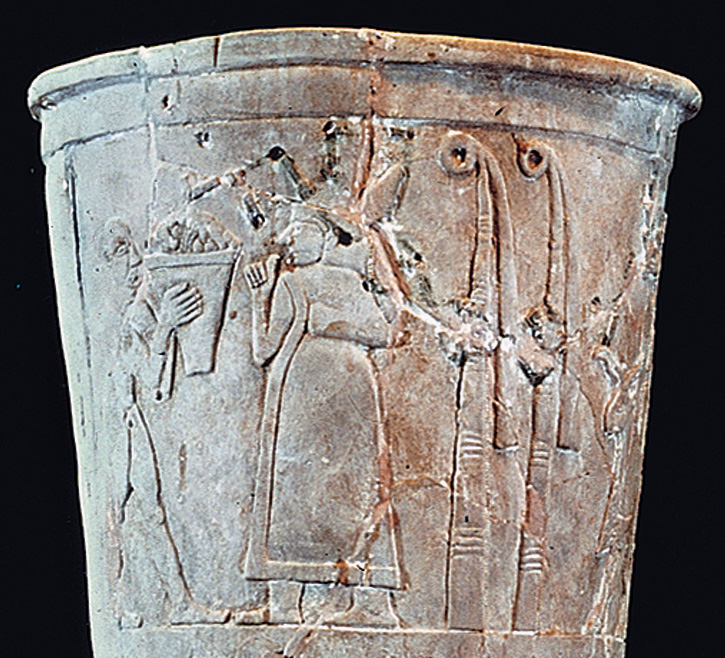
Offerings to Inanna, with ringposts. Uruk, 3000 bce.
Wimber starts with Eanna, the temple of Inanna (not Ishtar, as written, at least not until the Akkadians overwhelmed the Sumerians). It was very ancient, originating at the venerable date of 3300 bce. She builds a systemic case, temple by temple, to show that the Sumerian-Akkadian-Babylonian sanctuaries became models for temples over the entire region. She summarizes: “the most common elements include open-air courtyards, non-symmetrical plans, bent-axes, an inner sanctuary or holy of holies, altars, ‘high places’ or podia [temple platforms], some kind of water feature, and gateways with towers or obelisks.” [33]
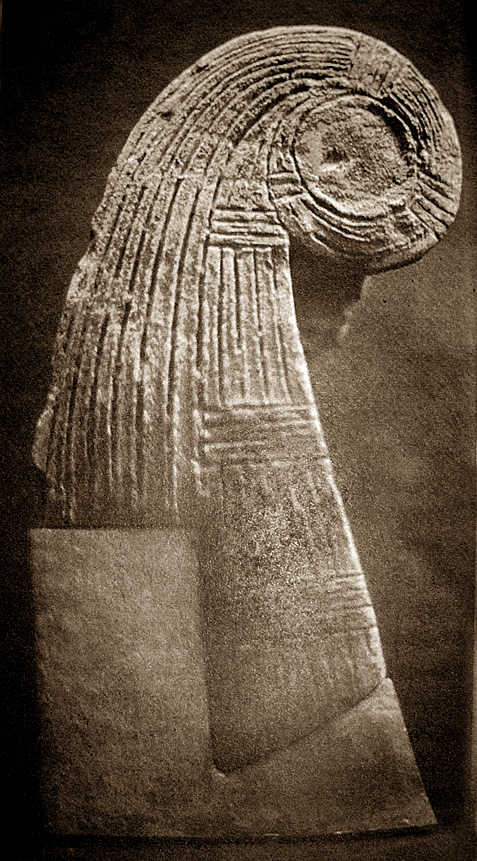
Wimber interprets the “ring-post” of Inanna as a pillar, possibly an early form of the pillar goddess. (Not so sure about that.) It was a bundle of reeds, which the early Sumerians used to construct houses—and temples. They coiled the tips of the bundles around into a spiral pattern. This became the glyph for Inanna’s name and symbolized her temple, as depicted in many reliefs and ritual objects. [9, 88] The reed-bundle style of earth-architecture has been preserved by the “Marsh Arabs” in southern Iraq (but
Spiralled reeds of Inanna
without the spiral coils which seem to have been deemed too fraught with non-monotheistic significance, and so the ends are chopped off instead). Their beautiful reed houses represent a heritage going back at least 35 centuries.
Later temples were built of brick, with soaring high walls. These temples are laid out asymmetrically, with chambers not aligned but in “a bent axis” that obscures the line of sight to the inner sanctum. They have multiple chambers and side courts with open air altars where libations and incense were offered. These altars sometimes were constructed as houses for the deity. The main altar was high and accessed by steps (already shown on ancient vases from Eanna, and which continued to be built into Hellenistic times. Steps also led to the roof where sacrifices were offered, as at the temple of Ishtar in Babylon. [8-9, 18] This Iraqi temple prototype spread and influenced temples in Syria, Lebanon, Israel/Palestine, Jordan and even beyond.
These temples typically had an apsu (water tank) in the courtyard, like the Inanna temple in Nippur. Or they had a lake (Hierapolis) or spring (‘Ain Dara) or, at minimum, a water basin. [18] Wimber draws illuminating parallels of these to the water basin in the courtyard of Solomon’s temple, explaining, “The term apsu stems from the ancient Mesopotamian belief in an underground freshwater ocean which fed the rivers and lakes. The word for the basin in Hebrew was yam, meaning ocean.” [27] (Interesting tidbit!)
Many indications point to ritual banquets, which are depicted in temple art, such as the Sumerian votive plaques from Inanna’s temple at Nippur, around 2750-2600 bce. [11] Remains of food offerings “attest to large communal food rituals.” Benches along three walls of the side chambers have also been proposed as feasting places, at temples of Atargatis at Dura Europos and on Delos; at Baalbek and Palmyra, and at the Jordanian temples Khirbet et-Tannur and Qasr al-Bint. [21, 48, 103]
Shaushka and the many Ishtars
In later periods, under succeeding dynasties and epochs, the temples of Ishtar were rebuilt again and again, retaining the traits of the earlier shrines, at Agade, at Nineveh, and in new countries that adopted her worship. [17, x] In these places Ishtar sometimes ceded pride of place to the local goddess, as she absorbed traits of Shaushka among the Hurrians and Hittites, or was paired with a new consort, as with the weather-god Hadad in Syria. The
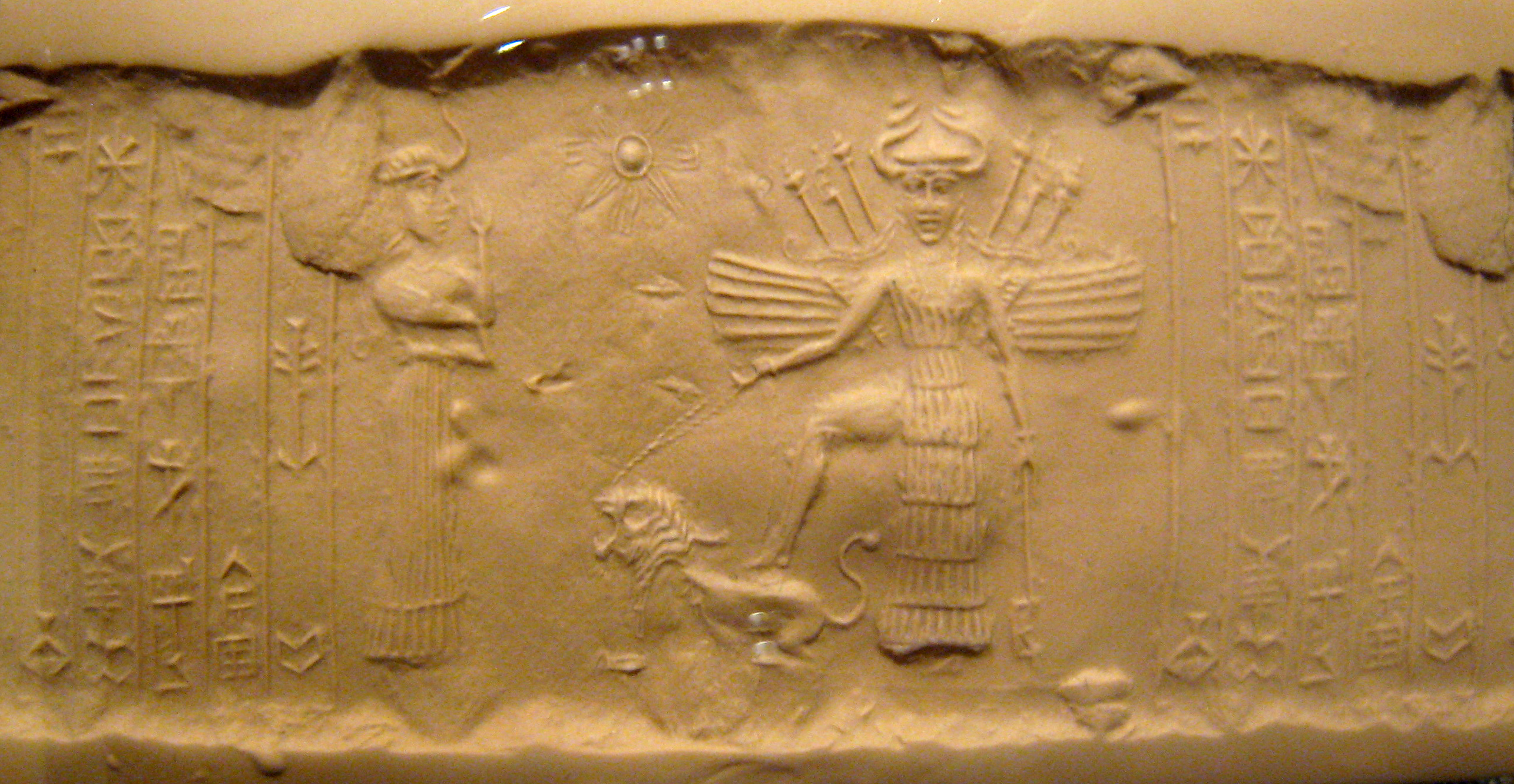
Ishtar seal, with her lion, star, wings, and the me
Ishtar temples took on place-specific characters. She of Babylon is the most famous because of the Ishtar Gate, but there are others: Ishtar of Shamukha, the very martial Ishtar of Arbela, an Ishtar of the Battlefield, and probably the most celebrated, Ishtar of Nineveh. [Beckman, 4-7]
“She of Nineveh” was often called by the Hurrian title Shaushka, the “Great One.” She was the head of the Hurrian pantheon, as shown by letters to Amenhotop III from the king of Mitanni, which invoke her opposite the Kemetic sun god. She also turns up as the primary deity at the Syrian city of Alalakh. This is a significant fact about Shaushka and Ishtar: it’s not just that these societies had goddesses, but that a Goddess was their primary deity. Shaushka, “the dweller in Nineveh,” remained the city’s great goddess for over 15 centuries. The first known mention of Nineveh is in an inscription about offering a lamb to Sausha of Nineveh. She retained her unique Hurrian character to the end, even as she assimilated titles of the Sumerian goddess (“Ninlil, dweller in Nineveh”) and the Akkadian Ishtar. The prologue to Hammurapi’s law code calls him “the king who made the norms of Inanna glorious in Nineveh, in the temple Emeshmesh.” [Beckman, 2-7]
Shaushka entered the Hittite pantheon with as a goddess powerful in incantations and magic. She is called “the woman of that which is repeatedly spoken,” mistress of chant. An intriguing fragment gives a taste of these incantations: “The hot stones came forth from Nineveh and Mount…” The babilili rituals of Ishtar Pirinkir also involved incantations in Akkadian. One 15th century text refers to queen Taduhepa invoked Ishtar of Nineveh in a ceremony. [Beckman 1, 5-6, note 56]
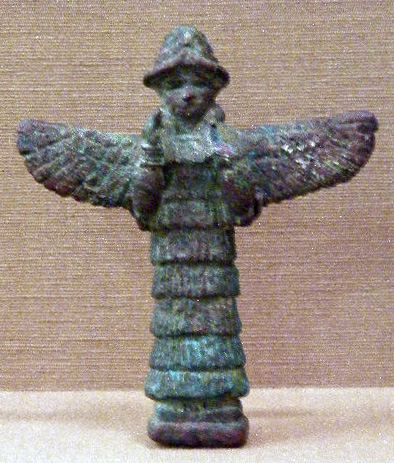
Winged Ishtar
There were also Syrian Ishtars of Mari and Ebla, and at least 25 different Hittite Ishtars identified by towns and mountains, especially in the southern, Hurrian country. Other texts refer to “all the Ishtars of the land of Hurri,” with Ishtar of Nineveh in first place The multiplicity here is not accidental; since separate offerings were made “to large numbers of such Ishtars.” Ishtar never made it to the top of the Hittite pantheon, but was assimilated to lesser goddesses such as Tashimetti, called “Ishtar the Queen,” and Takhakshaziyati, known as the “Ishtar of Arising,” or in an alternative translation, “Ishtar of Freeing.” [Beckman, 3-4]
Also in Hittite country, Shaushka / Ishtar of Shamukha seems to be identical with DINGIRGE, “Deity of the Night.” Her golden image had its back studded with discs of carnelian, lapis, and other precious stones, “like beads,” including the “life-symbol and morning star.” Beckman remarks that “the ornamented rear suface seems to represent the night sky.” [7, note 80]
Ishtar Temple at Ebla
The Syrian temples of Ebla, like its art and writing, followed the southern Mesopotamian pattern. The temple known as P2 was dedicated to Ishtar: “Figurines of lions found near the temple firmly show that the temple was dedicated to Ishtar, as do jars depicting doves and nude women, two symbols of Ishtar. Cylinder seals found nearby show the image of a priestess standing next to a standard representing Ishtar and Hadad. The presence of a priestess on this seal indicates that at Ebla the Mesopotamian tradition of having priestesses in Ishtar’s cult continued.” [21]
Other intriguing finds at this Ishtar temple are the underworld offerings of “statues of snakes and nude female figurines found in ritual pits or cisterns under the courtyard.” [21] These offerings into the depths of Earth were also made to Ishtar of Nineveh: “She had chthonic associations, was on occasion approached through a ritual pit, and is once found in the company of the Sun Goddess of the Earth and the primeval deities. She is beseeched to cure disease, including plague, and asked to lift curses.” [Beckman, 6]
At another Syrian temple at Alalakh, an inscription warns that if anyone tries to attack the city that Ishtar will “impress feminine parts into his male parts.” This was a threat, not an offer! Other texts, such as the Great Hymn to
Cogendered aspects of Ishtar, shown by her split dress
the Queen of Nippur, state that Ishtar “turns men into women and women into men.” [22] The goddess herself had androgynous traits (including a bearded aspect associated with Venus as the male morning star, while her evening star aspect was female). She had transgender priests (male-to-female) who underwent castration. Nothing is mentioned about female-to-male trans folk participating. As usual, crossing the gender border from the female side is nearly invisible historically, and very possibly less socially accepted, or at a minimum, not institutionalized. Both Wimber and Stuckey highlight the cross-dressing, gender-switching, sex-altering powers of Ishtar. (Ritual self-castration was also, famously, found in the rites of Kybele, Ma of Commana, and Atargatis.) Stuckey brings out the less sensational, but central fact that Ishtar was also a healer, a plague-fighter, and a remover of curses. [Stuckey, online]
‘Ain Dara, Syria
Around 2000 bce the Hurrians become visible in what are now the Kurdish lands, bridging Syria, Iraq, Iran, and Turkey. This people spoke a language related to Urartian (in what later became Armenia) which may have been
Puduhepa, Hurrian priestess and Hittite queen
related to northeast Caucasian languages. The Hurrians came under Hittite rule, but as sometimes happens, they hugely influenced the religion of their overlords. One woman in particular, the priestess Puduhepa, is known to have succeeded in importing Hurrian deities into Hittite culture. She married the king and has been shown to have exerted considerable political and diplomatic power in her own right.
Around 1300 bce Hurrians built the temple of ‘Ain Dara, which flourished for seven centuries. It stood atop a hill near a spring, near Aleppo in northwestern Syria. This has been called an Ishtar temple, but Joanna Stuckey makes a good case that its goddess is Shaushka, “originally a goddess of the Hurrians.” Her name means the “Great One.” (See her excellent article. http://www.matrifocus.com/IMB08/spotlight.htm)
A stone relief found near the temple entrance shows the goddess in a diaphanous gown with clearly marked pubic triangle, and one leg bared in the Hittite style. (These marching Hittite legs exerted a farflung influence, particularly in Gorgon iconography).
Shaushka of 'Ain Dara Temple
The goddess is dual-natured; one side represents her as life-giver, her other side carries weapons or a quiver. (But this is uncertain; they also resemble wings, also an attribute of Shaushka, as well as the snakelike me [powers] that spring out of the shoulders of Inanna and Ishtar.) Images of a mountain god appear to represent the consort of the goddess. At the entrance of the temple the colossal footprints of the goddess, over four times human size, are carved into the stone block pavement:
The most unique depiction of deity found at Ain Dara are giant footprints on the stones entering the temple. Two feet are shown at the entrance, then a left foot followed by a right foot, thus depicting the deity striding forward into the sanctuary. [23]
The ‘Ain Dara temple shows strong Canaanite connections, including the Hathor-styled sphinx heads. As Joanna Stuckey points out, Ishtar, or rather Ashtart as she was known in Canaan / Phoenicia, “was also connected to sphinxes.” Wimber thinks all this lion iconography originates from Inanna / Ishtar. The lions and sphinxes at ‘Ain Dara certainly fit the profile of Ishtar, but they are associated with a Great Goddess throughout southwest Asia, from Asherah and Ashtart in Canaan to Anahita in Iran, and from Kybele in Anatolia to Atargatis in Syria and the goddess, probably Al-Uzza, in Jordanian temples.
Female Sphinx at 'Ain Dara Temple, Syria
I think we are looking at something far older that predates any named goddesses known from inscriptions. We can look back to the lion-woman sculpture from the borderlands of Iraq and Iran, 4th millennium bce. Even more
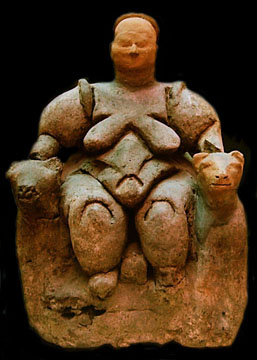
Goddess of Leopard Throne, Çatal Höyük, Asia Minor
ancient is the leopard-throned goddess at Çatal Höyük. She cannot be discounted as a precedent in this historical chain, especially when we look at those thrones flanked by lions or sphinxes. Many scholars will say, You can’t prove that there was continuity. But Wimber’s thesis is one more demonstration among many of the tremendous conservational power of religious culture. Iconography, building styles, customs endure across millennia, in spite of conquests, the rise and fall of empires, language changes, and new cultural influences.
Yet Wimber thinks that Kybele somehow got her lions from the Greeks. She writes, “Cybele is never shown with lions until the Greeks began influencing her cult and perhaps the Greeks equated her with lions because they saw that as typical of Oriental goddesses.” [115] I can’t agree, given the Anatolian precedents of Kybele, and her connections to Kubaba and Ma and Hebat. Wimber is on firmer ground in resisting attempts to interpret the lions of Atargatis as a late derivation from Kybele.
Ashtart at Sidon
A 4th century bce chapel to Ashtart was built into an older temple of the god Eshmun. Here Iraqi influence is visible in the stepped platform of the temple. Inside the shrine stood the throne of the goddess sculptured with sphinxes. Around the throne was a pool of water, fed by “multiple water channels and basins connected to a spring which were probably used for water rites and ablutions.” The author links these to “water pouring rituals associated with Astarte,” and refers to urns standing in the shrine, one of which is depicted in a bronze from Sidon in the form of another sphinx-flanked throne. [31-32] She places this sanctuary in historical context:
The chapel of Astarte in Sidon is one of the last religious structures related to the worship of the long line of female fertility goddesses that was built before Hellenistic culture began to heavily influence the Near East. [32]
The ‘Ain Dara temple has been proposed as a prototype for the temple of Solomon in Jerusalem, whose structure (as described in the Hebrew Bible) closely mirrored it. The biblical account credits the Phoenician Hiram as architect, so this should not be too surprising. This comparison leads us to one of the most interesting themes in Wimber’s paper:
Lady of Tutugi/Galera, Spain. She was carved in Phoenicia or Syria, and exemplifies the sphinx throne of their goddesses. Libations were poured through her head and flowed out into the basin.
the empty thrones which, as she shows, are related to the goddess temples of Ashtart and Atargatis.
The temple of Solomon had no deity statue; only “an empty mercy seat with flanking cherubim represented the presence of God in the temple.” [28] Wimber compares this to the empty lion throne in the Ashtart chapel at Sidon, Phoenicia; the “empty throne dedicated to the sun located just inside the temple” of Atargatis at Hierapolis”; the “empty throne flanked by lions which sat just across from the theater in the terrace of the sanctuary” at Delos; and possibly also “the motabs referred to in Nabataean inscriptions as thrones of the deities” in Jordan. [42-4, 75-6, 111]
Some confusion creeps in when Wimber writes, “It is evident that Asherah was a descendent of the Babylonian Ishtar as seen in the account in Ezekiel in which the Israelite women were in the temple weeping for Tammuz, the Babylonian lover of Ishtar whom she rescues from the underworld.” [29] This passage does not name Asherah, and the real analogue would be Ashtart (rendered as Ashtoreth in the Bible). It is all too common to see Asherah conflated with Ashtart/Astarte, but this is an error. These were distinct names whose apparent similarity in transliterated Roman letters is deceptive. Different characters are used for that first letter in Western Semitic, and the names have different roots. And why would the book of I Kings list the two goddesses as separate if they
Ashtart with Hathor head and snakes, standing on her lion
were the same entity?
Asherah is a mother goddess, as we see from her Ugaritic form, Athirat, who is titled qaniyatu elima, “progenitrix of the gods.” Ashtart has distinct qualities, not least her identification with Venus as the morning and evening star, her maiden and erotic qualities. I say this recognizing that the names we have from inscriptions are often titles, such as QDSU (“holy”), which may be shared for different goddesses, or belong to a single deity. But we have separate parallel streams in Hebrew, Ugaritic, and Akkadian inscriptions: Asherah, Athirat, Asheratu for the one; and Ashtoreth /Ashtart, Athtart, Ishtar, each with their own associations and contexts. There is plenty of reason to see these two as different goddesses with different traits.
Similarly, Wimber writes, “This cult demonstrates the continuity of some element of Ishtar’s worship in to the worship of Asherah. In Jeremiah 44:19 her followers burned incense, poured out libations, and made cakes for her. These cakes were made in the form of a nude goddess with exaggerated breasts and pubic region.” [31] That is possible, even likely, but it is a surmise. Another possibility is cakes shaped like vulvas—or both, or other shapes, such as the palms, lilies, and lions associated with the goddess.
Kristina Michelle Wimber, “Four Greco-Roman Temples of Fertility Goddesses: An Analysis of Architectural Tradition.” Thesis at Brigham Young University, 2007
 trade, but their hard work did not bring wealth. She refers to matrilineality among the Yombe, but this too was now being leveraged for the political advancement of men. “Women were also centrally involved in the most powerful therapeutic association in lower Congo.” This was the lemba association. As Martin describes it, lemba was driven by traders, chiefs, and powerful men, (who were much concerned to suppress any witchcraft directed towards their wealth), but gradually lemba specialists moved more to pregnancy and childbirth. (I have to wonder if this was not the original focus suborned by the political developments referred to earlier.) [30,23]














You must be logged in to post a comment.