Deprecated: Function WP_Dependencies->add_data() was called with an argument that is deprecated since version 6.9.0! IE conditional comments are ignored by all supported browsers. in /home1/sourceme/public_html/veleda/wp-includes/functions.php on line 6131

Deprecated: Function WP_Dependencies->add_data() was called with an argument that is deprecated since version 6.9.0! IE conditional comments are ignored by all supported browsers. in /home1/sourceme/public_html/veleda/wp-includes/functions.php on line 6131

Notre Dame de la Vie III: Archaic Celtic Goddess

Notre Dame de la Vie is a Celtic Goddess in a sculptural style that strongly resembles two other goddesses who appear to date to the same antiquity. Their faces have similar features; so do their hoods or headdresses. One of these sculptures is from Guernsey island in the English Channel and the other is from Caerwent in southern Wales.

La Grand-mère du Chimquière, Guernsey Island

La Grand-Mère du Chimquière belongs to a larger group of female statue-menhirs from the late neolithic. Her name means Grandmother of the Cemetery. She currently stands at the entrance of the churchyard at St-Martin de Bellouse. (Funny, both she and Notre Dame de la Vie are linked to the same  saint, the earliest christianizer in Gaul (d. 370 ce.)

At one time a stone with two hollows for offerings lay before her, but has since been removed. Nevertheless, the people kept up the custom of garlanding her and placing offerings. “Even in the nineteenth century it was ‘lucky to place a little offering of fruit or flowers, or to spill a few drops of wine at the foot of the statue—‘c’etait une Pierre sante…” (It was a holy stone.) [Kendrick, 17] These offerings continue today, as many pictures online demonstrate.

At one time the statue stood near the Church porch, facing East but, probably because too much veneration was paid to her by parishioners, a zealous churchwarden ordered her destruction.  It was broken in two but such was the outcry that the statue was repaired and placed in its current position.  A metal spike now holds her together but the crack is clearly visible. [http://www.stmartinschurchguernsey.org/historyofthechurch.htm ]

This deliberate breakage (visible in the photo above) was committed in 1860, around the time of the assaults on Notre Dame de la Vie. This period saw another wave of concerted destruction of ancient goddesses of, in Kendrick’s words, “long traditional sanctity.” The site quoted above provides another crucial piece of information: “The church stands on the site of a Neolithic tomb shrine below which two springs emerge.” So this too is a fountain sanctuary.
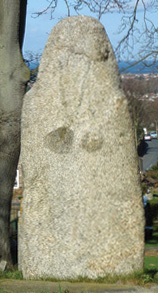
Megalithic Goddess at Castel, Guernsey

Another statue-menhir on Guernsey stands on a hill near the center of the island, at Castel. In the 6th century a church was built on her site, and she was buried in the area below its altar. So we see both supercesssion (the new religion hiding and placing her beneath) and incorporation (the would-be converts of that time knew that she was still there). In the late 1800s she was rediscovered and again placed outside. The Castel statue-menhir is in the classic form of the megalithic era: a lightly tapered stone pillar with breasts and  necklace. She also wears a headband. Many French statue-menhirs have faces, but this one does not.

La Grand-mère probably looked similar, originally. But her head and shoulders were recarved by Celtic hands, probably during the La Tène period. They added a face, cut out her neck and sharply defined her shoulders, and engraved a necklace or collar. None of these correspond to any style of the megalithic period. (Thevenot compares her to another breasted statue menhir enclosed in a wall at Lichessol, near Saint-Agrève in the Ardèche region, whose head seems to emerge from a round hood as well. But, no photos are available of her, so far.)

Another important, and comparable, Celtic statue is the Goddess of Caerwent. She was venerated by

Goddess of the Silures, Caerwent, south Wale

the Silures, a Celtic tribe of south Wales. Before the Roman conquest, they placed her in a deep ritual deposit pit, eleven feet underground, on the grounds of a sanctuary that later became the Roman temple at Venta Silurum. (The Roman name for Caerwent was Venta Silurum, “marketplace of the Silures.”)

The sandstone statue presents a solemn seated woman holding a branch in one hand and a sphere or fruit in the other. Her flat mask-like face has its lips parted in a slight smile. Her somewhat triangular head is longer than the minimal legs. (These proportions are common in older Celtic sculpture in Britain and Gaul, for example a female statue from Bourges.) The Goddess is naked except for a hood or cape set back on her head. Her hands meet where her legs part, and at certain angles those spindly legs look like a vulva-portal, with a deep hollow between them. I’ve always thought of her as a proto-sheila. The worn surface of the sandstone shows that she’s ancient, how old we have no way of knowing for sure.

Now let’s compare the faces of the three goddesses or, in the case of la Grand-mère, ancestors. All represent an ancient Celtic style of stone carving that predates the Roman conquest. All have flat faces with large oval eyes and long noses and wear some kind of hood. Originally I was thinking that only Notre Dame de la Vie was associated with a spring sanctuary, but now find that so was La Grand-mère du Chimquière: “The church stands on the site of a Neolithic tomb shrine below which two springs emerge.” [from the offical website of St. Martin’s Church: http://www.stmartinschurchguernsey.org/historyofthechurch.htm] And re-reading Anne Ross’s magisterial study Pagan Celtic Britain, I find that she thinks the Caerwent Goddess in Wales may have been connected to a healing shrine of the waters. [Ross, 247, 269] Be that as it may!

Left: Grand-Mère, Guernsey; Right: Notre-Dame, Savoy

These photos show the close-set oval eyes with strong upper ridge, the long nose, and nearly identical mouths on the Guernsey re-carve of the statue menhir and on the Goddess of Life fountain goddess in Savoy. The hoods or headdress are also comparable. No frontal angle photo is available as of this writing for Notre Dame de la Vie, who bears many scars from mutilations inflicted in the mid-19th century.

Left: Notre Dame de la Vie; Right: Caerwent Goddess

Here the angle of the photos is more comparable. The face of the Caerwent goddess is more triangular but both have the same flatness, close-set oval eyes, and headdress. What I’m trying to do here is to show artistic patterns in ancient Celtic sculpture from an early cultural layer that predates the Roman empire and has gotten very little attention. Here’s another view of the Grand-mère du Chimquière:

Grand-mère du Chimquière, garlanded

© 2012 Max Dashu

Sources:

Emile Thevenot, Divinités et Sanctuaires de la Gaulle, Paris: Fayard, 1968, pp 191-198.

Kendrick, Thomas Downing, The Archaeology of the Channel Islands, Volume 1. Taylor & Francis, 1928

Ross, Anne, Pagan Celtic Britain: Studies in Iconography and Tradition. Chicago: Academy Chicago Publishers, 1996 (1967)

St. Martin’s Church website: http://www.stmartinschurchguernsey.org/historyofthechurch.htm

Notre Dame de la Vie II: Savior of Infants

Saving the babies: fountain goddesses and respite baptism

Another amazing aspect of the ancient sanctuary of Notre Dame de la Vie was as a compassionate place of refuge from harmful religious dogma. It became a sanctuaire de répit, or “respite sanctuary.”

French women immersing a baby in a healing well

Respite from what? –from the church doctrine of eternal damnation of those who died without being baptized. Notre Dame de la Vie was said to miraculously revive stillborn babies, or newborns who died before a priest could baptize them. People were bringing their dead infants for her intervention from at least the 1600s, as we know from records of hearings in 1664 and 1669. [197] Notre Dame de la Vie thus joined to a larger body — mostly local forms of the Virgin Mary — of female divinities who embodied compassion, mercy, and grace.

Church doctrine forbade the baptism of dead children, and held that they would go to hell. Toward the end of the middle ages, the idea of limbo was invented to soften the harshness of a dogma that caused so much suffering. Mothers already grieving their infant’s death could not stand the thought that it was doomed to be forever damned. Limbo meant the “edge” of hell, and the idea was that the babies would remain there, outside the torments of the damned, along with other good souls unsaved by baptism. But limbo has never enjoyed the status of church teaching. In any case, never being baptized  meant the baby would never enjoy the beatitude of heaven, but would spend eternity as an outsider. Limbo or no limbo, the clergy would not allow stillborns to be baptized or buried in consecrated ground.

Attempting to revive dead baby for baptism

The common people refused to accept these cruel ideas. They sought divine intervention from another source, from Notre Dame de la Vie, or from the Blessed Virgin at other chapels that developed a reputation as respite sanctuaries. Parents would carry the dead child in all haste to the nearest shrine, lay it at the altar of the Virgin, light candles and ardently pray for its revival while a priest performed a rite.

All this depended on the participation of priests, because they had a total monopoly on baptism. Sometimes the vigil for revival would go on for days.  Any sign of movement, breath, change of color, or even passing gas or fluid—all of which are common biological occurrences after death—was taken as a miraculous resusciation or “recovery.” The priest would quickly baptize the child, and in virtually all cases, the child would die “again.” It would either be buried in a special cemetery at the respite sanctuary, or be taken home for burial in the village.

Baptizing a "revived" infant at Notre-Dame des Fleurs de Villambray, Oise

The “respite” baptisms gave peace of mind to parents, and allowed children to be buried in consecrated ground. At St-Martin de Belleville, the record from 1664 says that an uncle brought a dead infant to Notre Dame de la Vie. The curé testified that the baby was seen to open its mouth and move its tongue around, and that its closed fist opened, extending its fingers. This allowed the vicar to baptize the baby, which lived several more hours. Then it was buried in a plot used for foreigners. [197-8] This indicates that the clergy involved still regarded the case as somewhat iffy. The priest performing the baptism would pronounce words to the effect of, “If you are alive, I baptise you.” The hierarchy were much more dubious about such cases, and put pressure from above to quash this practice.

The earliest evidence of respite baptisms comes from the late 13th century. Church condemnations of these grassroots miracles appear to begin in 1452 with the synod of Langres. Others followed, with denunciations by bishops at Sens (1524), Lyon (1577), Besançon (1592 et 1656), and Toul (1658). But the hierarchy was obliged to repeat its prohibitions over and over as the respite ceremonies spread. They were fighting a cultural movement fueled by love and compassion, that defied their directives.

People were flocking to respite sanctuaries from Belgium all the way down through eastern France and over into western Germany, Switzerland, Austria and north Italy. Most of these shrines of compassion were chapels of the Virgin Mary. Hundreds of cases are on record just for the 1500s and 1600s, just for the most popular chapels for these baptisms, such as Faverney, Avioth, and others in eastern France. By 1729 pope Benedict XIV was forced to rule on the issue, in response to a huge upsurge of respite ceremonies in Bavaria and Schwabia. He condemned the rites and backed up the Inquisition’s position that the “signs of life,” unless they were cries or moans, were not enough to allow baptism, no matter how many witnesses.

Emile Thevenot points to two Burgundian respite sanctuaries that “sprang up in places where there were traces of a defiant custom around a spring cult presided over by a mother goddess.” [197-8]

Frau Holle like Perchta was a protector of babies, including the unbaptized

And that is exactly what had happened at St-Martin de Belleville. As we’ve seen, this sanctuary openly retained the original Goddess who predates even the Roman conquest and was centered around a healing fountain. The refuge its Lady offered to dead newborns connects to widespread folk traditions of pagan goddesses who were seen as welcoming and protecting unbaptized babies rejected by the Church. People linked these “pagan babies” — in Sicily they were actually called paganeddu, in Germany heiden, “heathens” — to the old goddesses, like Zlata Baba in Slovenia, or to faery women, like the Danish huldra. [Dashu, 2007. Read more about folk traditions of the “pagan babies”]

In the German Orla-gau, Perchta keeps little ones who died before baptism. She is ferried across the river with them, recalling Greek and Scandinavian myths of crossing the underworld river of death. Perchta is called queen of the heimchen (“crickets,” an affectionate term for the dead babies). One story says that she once lived in the fertile Saale valley. She fructified the land by plowing it underground, while her heimchen watered the fields. “At last the people fell out with her, and she determined to quit the country.”

Modern view of Frau Perchta as Goddess of the Winter Night

So Perchta departed. Late on the eve of her holyday, the ferryman at Altar was confronted by a tall, stately lady surrounded by crying children. She demanded to be ferried to the other side of the river, and got into the barge. The heimchen loaded in a plough and tools, lamenting that they had to leave that lovely land. Perchta made the ferryman cross again to get the rest of the children. The whole time she was mending the plough. She gave the leftover chips as her fare. The ferryman only took three; by morning they had turned to gold. [Grimm, 932, 276]

Of course, these pagan loyalties, however stubbornly persistent, gave way to the Catholicized Goddess over time. But popular Marian devotion looked very different than the theologian’s concept of the Virign as intercessor. She acted much more like an alternative savior who repudiated the notion that infants who died in the womb or soon after birth were doomed, or at least outcasts. She embodied the compassion of the ancient Goddess whose successor she was.

© 2012 Max Dashu

Sources:

Emile Thevenot, Divinités et Sanctuaires de la Gaulle, Paris: Fayard, 1968

Brigitte Rochelandet, “Sanctuaires à répit, limbes de l’éternité,” Extract from Pays Comtois, No. 63, Online: http://jeanmichel.guyon.free.fr/monsite/histoire/metiers/sanctuairerepit.htm

“Sanctuaire à répit.” http://fr.wikipedia.org/wiki/Sanctuaire_%C3%A0_r%C3%A9pit

Max Dashu, “The “Pagan Days.” Matrifocus Quarterly, Vol 6 – 2, 2007  http://www.matrifocus.com/IMB07/scholar.htm

Jacob Grimm, Teutonic Mythology,  Vols I-IV, 4th edition translated by James S. Stallybrass. London: George Bell & Sons, 1883

More sources on Sanctuaires à répit:

Jacques Gélis, L’arbre et le fruit. La naissance dans l’Occident moderne, XVIe-XIXe siècle, Paris, Fayard, 1984.

Jacques Gélis, Les enfants des limbes. Mort-nés et parents dans l’Europe chrétienne, Paris, Audibert, 2006.

Fiorella Mattioli Carcano. Santuari à répit. Il rito del ritorno alla vita o ” doppia morte ” nei santuari alpini, Priuli & Verlucca -Ivrea 2009

Next: Notre Dame de la Vie III: Archaic Celtic Goddess

Notre Dame de la Vie: Our Lady of Life

An ancient stone goddess watched over a sacred spring at Saint-Martin de Belleville, on the French side of the Alps. Her veneration in Savoy goes back before the beginning of the written record. An influx of Celtic culture swept into this high valley of Doron de Belleville around the 400 bce, and it is full of early sites of the La Tène era.

Notre Dame de la Vie, before 1960

The Goddess statue was probably carved in the early centuries bce. She stands just over five feet tall, with a body that widens into a skirt at the base. Her eyes are large and close-set, with a “grave and meditative expression.” She holds a large cylindrical vessel over whose surface spill flat carved drops of water:

“These globules appear in strong relief, under each of her hands, three on one side, four on the other, and form a liquid flowing out of the reservoir, first obliquely, then vertically.” The sculpture symbolically conveys “the birth of a spring, over which the feminine deity presides.” [Thevenot, 194] The fountain poured into into a stone cist. Thousands of people came there to drink its waters, perform ablutions, and ask for healing and other blessings.

Over a long process of Christianization—one that was never completed—successive chapels were built at the spring sanctuary of this Goddess. In countless places around Europe, pagan sanctuaries were christianized by building churches on the spot, and bringing in a statue of Mary or another saint. But what happened here was exceptional. For nearly two millennia, an ancient Celtic goddess remained in her spring sanctuary, disguised under the Christian nomenclature of the Virgin Mary. She was given the thinly-christianized title Notre-Dame-de-la-Vie, “Our Lady of Life.”

The clergy moved the Goddess from her original position, probably among the rocks of the spring, and had her built into the foundation wall of the most recent of the chapels. Otherwise unchanged, the Goddess of Life continued to receive the devotions of Savoyards at her mountain spring. As Emile Thevenot says, “the church did not even ‘substitute’ the Marian cult for the mother-goddess, personification of the spring of Life. It was enough to discreetly juxtapose it, and the old statue continued to receive its due of tribute, even as the rite of ablutions was kept going.”

Veneration of the Goddess and her waters continued into modern times, when she was esteemed as a source of tremendous healing power. Records show that extremely rich offerings were being made at this shrine in the 1600s and 1700s (and doubtless many more humble ones). In the same time period, dozens of  murals were painted in the chapel depicting stories of miraculous cures by the Lady.

The spring water flowed into a stone tank, and in recent times was rechanneled through a pipe

The Goddess originally had full breasts. In the mid-1800s, a pious fanatic hacked them off—without doubt considering them too pagan, indecent, too full of naked female power. He left tool marks in the stone. Someone, probably the same person, also tried to drive a cross into her head, splitting the stone through the entire face of the icon. (This topping with crosses was often done to megalithic monuments and other known recipients of pagan reverence.) Someone drilled a hole into her neck, and passed a pipe through it to divert some of the spring water  through the opening. This did not work out well, because the photo above shows the ugly raw pipe bypassing the Goddess altogether. These damaging interventions made it necessary to patch the statue, with white cement visible in the picture above.

An eyewitness account from the 1930s describes one of the annual pilgrimages of to Notre-Dame-de-la-Vie. Savoyards came from villages near and far, often on foot, with their offerings and prayers. (One online account said that in the past surrounding villages pretty much emptied out to attend her annual festival in late summer. The chapel was furnished with special trunks for offerings of rye and wheat; people put cheeses and other dairy products near, and even on,  the altar. Live animals were tied up for later sale, with proceeds going to the chapel.

The witness saw women approaching a rough statue embedded in the wall that supported the chapel courtyard. The fountain poured into an old rectangular stone receptacle, the “tank of ablutions.” The women had brought clean linen to dip into the water and sponged their faces, eyes and breasts with it. Everyone regarded the water as “saving and fertilizing.”

The Goddess of Life after removal from the spring shrine

The Goddess of Life had survived christianization, medieval bishops, the Catholic Reformation, and even those 19th century mutilations — but not modernity. In 1960, church authorities removed the ancient statue from her place at the spring. They put her in a covered gallery, leaning against the west wall of the chapel. (Thevenot comments that this was “a real relegation.”) The Goddess no longer stood in the open air, and there was no longer room for people to gather around her. The receptacles for depositing offerings remained in place, but the pilgrimages fell off after the goddess was enclosed by the church. [191]

This move by the priests succeeded, at long last,  in driving popular veneration in a more conventional, doctrinal direction. It refocused attention to the chapel, adorned with standardized Catholic art.  It made Notre Dame de la Vie disappear from view, literally. The only pictures I’ve ever been able to find of her are in Thevenot’s book, written over 40 years ago.

Thevenot tells of another water goddess in the mountains of Savoy who survived under a Christianized veneer. The chapel of Notre Dame des Vernettes was built around another “miraculous and healing” spring to which people made pilgrimages. “We are assured that, even in our times, the ablutions, condemned by the hierarchy, continue to be practiced in an open or clandestine manner.” [194] So the struggle to suppress ancient cultural practices continues.

Lots of other pagan survivals exist in these mountains. La Pierre Chevettay (the “Owl Stone”) in the little hamlet of Villarenger hamlet is a huge block balanced on a small square. On its surface are six or seven cupules connected by grooved lines. People said this sacred stone preserved the village from floods and fires. It underwent the same de-paganizing indignities as Notre Dame de la Vie which, however, may have saved it from being destroyed entirely: “Numerous crosses were engraved on it to christianize this magic stone.” [192]

Going further afield, Madonnas in other parts of France were often located near springs and wells. The Black Virgins of Rocamadour, Vassivieres, Cusset, Clermont and Chartres all stood near wells or

Black Madonna of Vassivières, Auvergne

fountains. In Clermont, the tiny, very old black statue of Notre Dame du Port stood at a subterranean altar next to a sacred well. The Lady of la Font Sainte (“holy spring”) was carried in procession to and from her summer and winter shrines.

A legend from around 1400 describes how similar processions with the image of Notre Dame de Vassivières originated in a struggle between the peasants and clergy. The highland altar of the Black Madonna of Vassivières stands near an ancient spring venerated since Celtic times. Ecclesiastics removed her statue down the mountain to a church in the town of Besse. “Here the priests could keep an eye on her, rather than leave her in the hands of the laity in her outdoor shrine in the cow herding hamlet.” [“Vassivière”] But she soon vanished from the church. An old woman bringing her cow to the town market told people that the Lady had reappeared over the sacred fountain in the heights.

A tug-of-war followed: the priests kept taking the goddess to the church in Besse but the peasants always managed to smuggle her back to Vassivières. Finally the clergy struck a compromise with the rural people that allowed her to stay the summer in her highland sanctuary, but to spend winters at the Besse church, in captivity like Persephone. [from Frances Marion Gostling, Auvergne and Its People, 1935] The church set a new condition for allowing the Lady to return to her mountain: a priest had to be present to supervise what people did. A report from 1321 refers to the practice of many “profane and inappropriate” things of Vassivières. “They say strange things were practiced here. We don’t know what.” [“Vassivière”]

© 2012 Max Dashu

Sources:

Emile Thevenot, Divinités et Sanctuaires de la Gaulle, Paris: Fayard, 1968, pp 191-198.

“Vassivière: Our Lady of Vassivière.” http://www.interfaithmary.com/pages/Vassiviere.htm

Next: Notre Dame de la Vie, the compassionate savior of infants