Deprecated: Function WP_Dependencies->add_data() was called with an argument that is deprecated since version 6.9.0! IE conditional comments are ignored by all supported browsers. in /home1/sourceme/public_html/veleda/wp-includes/functions.php on line 6131

Deprecated: Function WP_Dependencies->add_data() was called with an argument that is deprecated since version 6.9.0! IE conditional comments are ignored by all supported browsers. in /home1/sourceme/public_html/veleda/wp-includes/functions.php on line 6131

A Goddess in the Harley Psalter

Another mystery solved. Thanks to the British Library’s online database of Old English manuscripts, i’ve finally discovered what biblical passage was illustrated by one of the most intriguing Pagan-themed medieval drawings. It appears in the Harley Psalter, thought to have been created at Canterbury circa 1020-40, as a copy of the 9th century Utrecht Psalter. Here’s the picture (click to enlarge):

Illustration with Psalm 108, Harley Psalter, 603 F56

I wasn’t sure what biblical passage this illustrated, though i could see the word Psalmus, and now can make out the Roman numerals for 108. But the picture clearly reflected medieval Christian themes from Europe, and what has intrigued me since the early 1980s is its evocation of the clergy’s campaign against folk goddesses. This repression of female deities in popular religion is attested by numerous episcopal decrees and priestly confessional manuals, including the Corrector Burchardi, the Canon Episcopi, and earlier writings by Regino of Prum and Raterius of Verona.

What’s going on in this picture? In the lower panel, naked Pagans pray to a Goddess who is dancing on a stone. Beside her is a Tree of Life, which has a snake, garland, streaming libation vessel, and cornucopia. It could be argued that the Snake and Tree are inspired by Genesis, except that they are also common themes in Germanic religion, for example in the Matronae stones of the Rhineland (2nd-3rd century CE), and indeed around the world. So they predate the christianization of western Europe. The cornucopia originates with the Roman goddesses, particularly Terra Ops, Ceres, and Fortuna, whose bounty it symbolizes. (It  spread far and wide during the empire, not only to Britain, Gaul and Germany, but also to Egypt, added to the attributes of Isis, and into southwest Asia, also in association with goddesses.) Garlands were also widely used in animist ceremonies throughout Europe. As late as 1431, Jeanne d’Arc was accused of hanging garlands on the Fairy Tree for le beau Mai, the old pagan holyday of May Day. The inquisitors and theologians still saw this as a damnable Pagan act.

Caped witch riding tiger, Schleswig church mural, circa 1330

The goddess is bare-breasted, but her cape or mantle hangs from the tree. Some medieval images of witches (for example, a stone panel at Lyons cathedral, and a German church mural in Schleswig, near Denmark) show witches as naked women clad only in capes. They are riding on animals, or on a broomstick. It is this very theme of shamanic theme of women’s flight on the backs of animals that the clergy targeted for repression. They reinterpreted the Women Who Go by Night with the Goddess, in diabolist terms. The Goddess was “really” the devil. Advanced early on by church fathers, this doctrine persisted in Frankish texts about the worship of “Diana” (the interpretatio romana often obscured the names of local ethnic goddesses) or of “the witch Holda” (the German goddess Holle).

Caped witch riding goat (and whirling a hare), relief from door of Lyons Cathedral. Directly opposite, another panel shows a lord in a castle tower ordering armed men with mastiffs to go after the witch.

The central theme in this Harley Psalter picture is supercession. The christian god-the-son is depicted above the goddess, as if replacing her. Not only is he placed above her spatially, but like her, he rests on a stone, and he too has the cornucopia streaming blessings. These are not Christian themes! but they were too deeply entrenched in the culture to be done away with. So they were appropriated as a step in the process of  supplanting Goddess reverence. Between the rival deities, a barebreasted woman tries to approach Jesus,  but an angel drags her away by her hair. I think this is significant since she is one of very few females in the Harley Psalter illustrations. You’ll note that all the other figures in the picture, even the Pagan worshippers and the angels, are male.

At lower left, soldiers are looting from a chest and kicking a man who is begging for mercy. Two of the Goddess worshippers are looking nervously over their shoulders at the soldiers, worried that they will be next. To me, this picture represents state attacks on pagans. Confiscation of their goods was one of the primary punishments, along with flogging and enslavement, for those who adhered to older ethnic religions  in the early middle ages. (It was primarily secular rulers who carried out these penalties, although priestly influence is clear, and bishops had powers both as secular and ecclesiastical lords.) The image comes from the portion of the Harley Psalter which was directly copied from the Utrecht Psalter. That would date the  scene to the 9th century, when such punishments were still widely inflicted on Pagans.

The picture appears as an illustration to Psalm 108. At first, reading the psalm, with its standard exaltation of the Hebrew god, you might wonder: What does this picture have to do with that? The answer appears toward the end of the psalm, where the biblical god claims various territories in the land of Israel. Singled out for humiliation are Pagan lands in modern Jordan, traditional enemies of the Hebrews: “Moab is my washbasin,
 on Edom I toss my sandal… Who will bring me to the fortified city?
  Who will lead me to Edom?” In the mind of the monks who illuminated this manuscript, the common thread seems to be the conquest and suppression of Pagans.

The biblical psalm doesn’t say a word about goddesses, but the Harley Psalter (or its Carolingian model, the Utrecht) understands this supercession as being specifically the displacement of Goddess veneration by the Christian god. In another picture, he is exalted over Mother Earth who is shown submissively gazing up at him, surrounded by her sons (no daughters). She still has the cornucopia, from which watery essence is flowing toward a tree — and the bare-breasted Mother is wearing a cape or mantle.

Mother Earth in the Harley Psalter, 603 F50

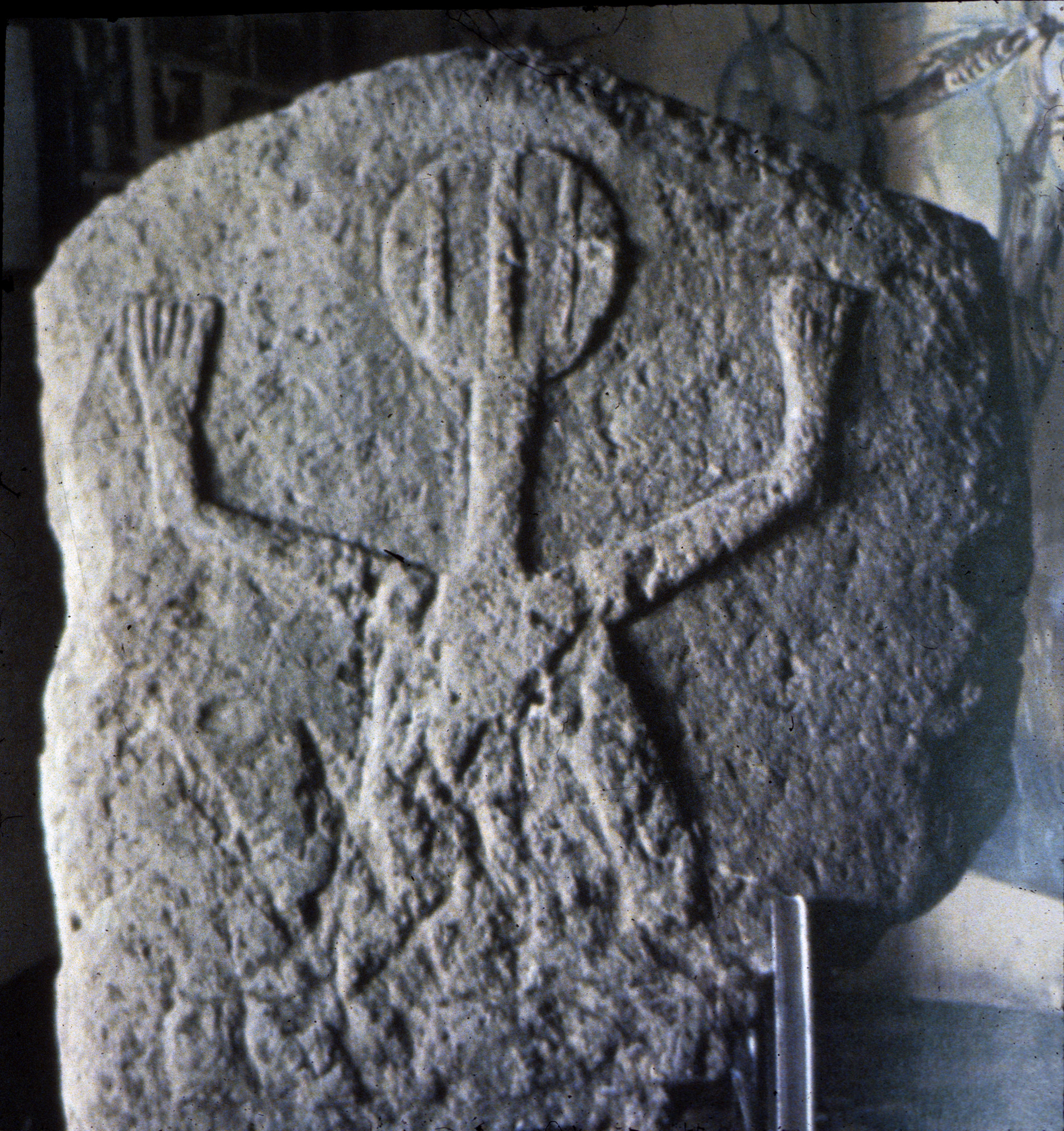
Eorthan Modor was just impossible for them to get rid of. She pops up even in the margins of Christian scriptures, on the ivory covers of prayer books, in murals of monasteries. In fact, she will outlive all human constructs — and that goes double for the concoctions of patriarchal theologians.

Edit May 2016:
The more I consider the symbolism of this goddess in the Harley Psalter (and the Utrecht Psalter on which it was modeled), the more likely it seems to me that she was intended to represent Herodias. The painting is contemporary with the earliest references to the Witches’ Goddess, in the Libri Duo of Regino of Prum and the Praeloquia of Raterius of Verona. The dancing woman ties in with the developing priestly myth of Herodias based on biblical accounts of the dance of Salome (the daughter of Herodias). This story came into wider circulation through the Heliand, a vernacular retelling of the Christian Bible in  Germanic epic style that was commissioned by Frankish emperor Louis the Pious in an effort to convert the Old Saxons.

The renaming of a Germanic folk goddess as Herodias, the  sexualized villain of the Christian Bible,  is discussed in my book Witches and Pagans: Women in European Folk Religion, 2016. The story has little to do with the historical reality of Herodias or her daughter Salome (who was also named Herodias), except that in her own time she was demonized for defying the sexual double standard.

Coming from a dynastic family did not mean that Herodias had an easy life. She was orphaned by her grandfather Herod “the great” [hate those titles] who executed her father and his brother in 7 bce. Then he arranged her marriage to Herod II, a move dictated by  dynastic politics. Herodias suffered in this marriage, so she made the bold move (unthinkable in her social context) of divorcing her husband. This act of self defense earned her public denunications from John the Baptist and then from the historian Josephus.

Josephus wrote, “Herodias took it upon her to confound the laws of our country, and divorced her husband while he was alive, and was [then] married to Herod Antipas.” [Antiquities of the Jews, www.gutenberg.org/ebooks/2848] The Gospels of Matthew and Luke say that her remarriage caused John the Baptist to publicly denounce her. Herodias’ second husband Herod Antipas had John arrested and executed. The Christian Bible recounts a fable that Herodias got her daughter Salome to dance for the king and demand John’s head in return. Modern scholars doubt that, and in fact Josephus says Herod Antipas executed him, fearing that he was stoking sedition.

But the gospel writers make her the villain, drawing on current Roman stories in which a prostitute makes the killing of a man her price. These unfair characterizations have lasted the better part of two millennia, as witness countless orientalizing paintings of the story.

Herodias by Paul Delaroche

Copyright 2012 Max Dashu

Suppressed Histories on FB

Visit Suppressed Histories Archives on Facebook!

Short blogs, especially image posts, every day on the Suppressed Histories page on Facebook. View the pictures via Photos, short articles via Notes.

You’re invited to visit ~and of course to Like and Share…

Max Dashu

Makeda, the Queen of Sheba (Saba’)

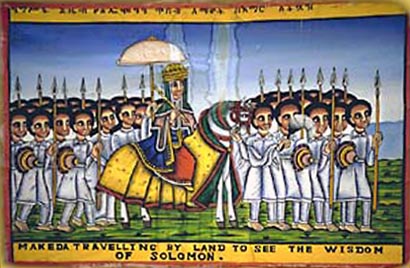
The Kebra Nagast (“Glory of Kings”) is the most important Ethiopian scripture. It describes the descent of Amharic kings from queen Makeda of Ethiopia and king Solomon of Judaea. (Sheba or Saba’ encompasses  Yemen in southeast Arabia but also Ethiopia, where the Amharic people speak a closely related Semitic language.) (See map) The story, compiled from various sources between about 400 to 1200, explains the origin of Ethiopia’s Solomonic line, including a claim that the Ark of the Covenant was spirited from Solomon’s temple to Ethiopia.

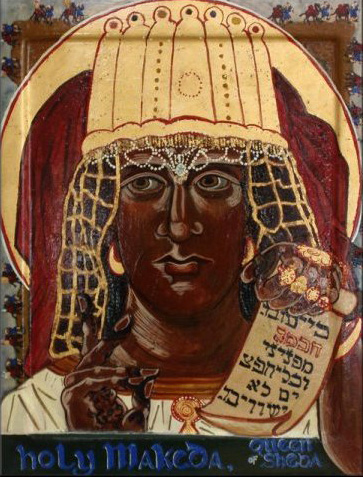
Makeda, queen of Sheba, wearing a classically African crown (other known examples are found at Ilé-Ifè, Nigeria, and a Sao ceramic sculpture of a crowned woman, near Lake Chad)

Hearing of Solomon’s wisdom from a traveling merchant, Makeda journeys to Jerusalem. After a colloquy with the king, Makeda declares, “From this moment I will not worship the sun, but will worship the Creator of the sun, the God of Israel.” The Sabaeans were famed in both Hebrew and Arabic texts for venerating the sun, moon and stars. The time frame of Solomon’s reign is historically consistent with a powerful state in Saba’. So the Ethiopian queen converts to Judaism.

The next twist, in this text, is that before Makeda departs, Solomon tricks her into sleeping with him. She had asked him to swear that he will not force her into sex. He agrees, on condition that she wouldn’t take anything from his house by force. He feeds her a lot of spicy food, and in the night when she reaches for water in her thirst, he appears and says she has broken her promise, having taken water, the most valuable of all things. (What happened to the famous tradition of hospitality here? and how is this not coercion?) So, says the Kebra Nagast, Makeda assents to sex with Solomon. As she departs, he gives her a ring for their future son. Then Solomon dreams that the sun leaves Israel.

Queen of Saba’ and her entourage bring precious gifts to the palace of Solomon (unidentified Ethiopian manuscript, probably the Kebra Nagast)

Makeda bears a son, Menelik. When he comes of age, he goes to Jerusalem for his father’s blessing, and is recognized by the ring. Solomon wants Menelik succeed him as king, but he insists on returning to Ethiopia. So Solomon puts together a noble company to go back with him. Angry at being forced to leave their home and families, these young men secretly take the Ark out of the Temple and away to Africa. Menelik is not implicated in this deceit, but he finds out along the way. He is divinely transported back to Ethiopia through the skies, thwarting Solomon’s attempt to recover the Ark. (Here the ancient theme of Solomon’s straying into idol worship under the influence of his many foreign wives takes a new turn; it now becomes his attempt to console himself for the loss of the Ark.) Menelik’s return is celebrated with great pomp at Axum, and Makeda gives up her throne to him. (Natch!) Ethiopia becomes “the second Zion.”

“The Holy Makeda” as a saint and prophetess

The Kebra Nagast includes a magnificent passage where Makeda speaks of her search for Wisdom:

I have drunk of her, but have not tottered; I have tottered through her, but have not fallen; I have fallen because of her but have not been destroyed. Through her I have dived down into the great sea and have seized in the place of her depths a pearl whereby I am rich. I went down like the great iron anchor whereby men anchor ships for the night on the high seas, and I received a lamp which lighteth me, and I came up by the ropes of the boat of understanding. I went to sleep in the depths of the sea, and not being overwhelmed with the water I dreamed a dream. And it seemed to me that there was a star in my womb, and I marvelled thereat, and I laid hold upon it and made it strong in the splendour of the sun; I laid hold upon it, and I will never let it go. I went in through the doors of the treasury of wisdom and I drew for myself the waters of understanding. I went into the blaze of the flame of the sun, and it lighted me with the splendour thereof, and I made of it a shield for myself, and I saved myself by confidence therein, and not myself only but all those who travel in the footprints of wisdom, and not myself only but all the men of my country, the kingdom of Ethiopia, and not those only but those who travel in their ways, the nations that are round about. [http://www.sacred-texts.com/afr/kn/kn097.htm ]

And then the Kebra Nagast returns to its central preoccupation, which is not Makeda herself, nor the wisdom of ancient Ethiopia of which she is the sole representative to be attested in written history. Instead, Makeda lays out the Solomonic line claim for the Ethiopian royal dynasty, a patrilineage going back to the Hebrew king. The book does credit her with building her capital Debra Makeda on a mountaintop. Other Ethiopian books give more details about Makeda’s parentage. The Ethiopian Book of Aksum describes her foundation of a new capital city at Azeba. Himyarite histories from Yemen also allude to this queen.

Queen of Sheba riding with sword and spear. Ethiopian MS.

At least one Ethiopian manuscript shows Makeda in connection with a labyrinth. One line in the Kebra Nagast, where Makeda speaks of “a star in my womb,” was undoubtedly intended as a reference to her future son and dynastic founder Menelik. But it can be read another way, as her womb in its own light: “And it seemed to me that there was a star in my womb, and I marvelled thereat, and I laid hold upon it and made it strong in the splendour of the sun…”

The Biblical Account

Sheba, Solomon, and son: modern

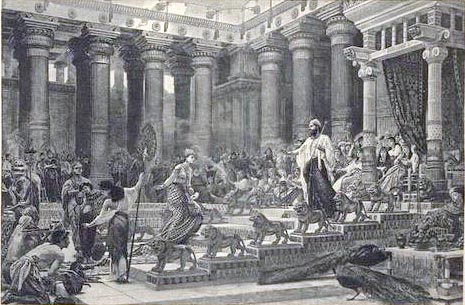
The oldest account of the Queen of Sheba comes from the Bible, in the book of Kings. It does not give her a name. “When the queen of Sheba heard about the fame of Solomon and his relation to the name of the Lord, she came to test him with hard questions. Arriving at Jerusalem with a very great caravan–with camels carrying spices, tons of gold, and precious stones–she came to Solomon and talked with him about all that she had on her mind.” [10:1-2] He answered every question she asked, and the biblical scribe describes her  as being “overwhelmed” by his wisdom, and by the wealth and splendor of his palace and kingdom.

The Queen praised Solomon and heaped him with precious gifts: “And she gave the king 120 talents of gold, large quantities of spices, and precious stones. Never again were so many spices brought in as those the queen of Sheba gave to King Solomon.” [10:10] The account says nothing about sex or a son, but goes on to describe tribute paid to Solomon, and the glories of Ophir in Arabia — or Ethiopia. In this account, the Queen is a peer, not a subordinated or inferior figure.

The Quranic Account

In Arabia, the Queen of Sheba is named Bilqis. Among the ruins of Mar’ib is a Sabaean temple platform with eight pillars, sometimes called the Temple of Awwan. Yemenite tradition calls it Mahram Bilqis, her  “sanctuary.” The Qur’an also contains an account about the Queen of Sheba. Again, it does not name her. Even though it treats her being Pagan as despicable, she is described as great in glory. The hoopoe bird tells Suleiman (Solomon) about Saba’:

Indeed, I found a woman ruling them, and she has been given of all things, and she has a great throne. I found her and her people prostrating to the sun instead of Allah, and Satan has made their deeds pleasing to them and averted them from [his] way, so they are not guided, so they do not prostrate to Allah… [Sura 27:24-25]

This passage reflects a memory of ancient Sabean queendoms with a strong dimension of spiritual leadership.

Suleiman sends a threatening message to Bilqis, “Be not haughty with me but come to me in submission.” Bilqis talks to her counselors, who say that they will go by her decision. She declares, “Indeed kings – when they enter a city, they ruin it and render the honor of its people humbled.” [27:35] This critique of warlordism is quite an extraordinary political statement for any ancient writing! and even more striking in being attributed to a woman ruler. The queen decides to send a gift, choosing the avenue of diplomacy, and to await Suleiman’s reply. He tells the emissaries that what Allah has given him is better than what they have, insults them for “rejoic[ing] in your gift,” and sends them back with a threat: “Return to them, for we will surely come to them with soldiers that they will be powerless to encounter, and we will surely expel them therefrom in humiliation, and they will be debased.” This is the declaration of a power-mad bully, not a man suffused in spiritual wisdom.

Before she set out to meet Suleiman, the Queen of Sheba locked and secured her throne. But the king sent a spirit to bring the throne to him, and disguised it, and tested her to see if she would recognize it. She did. Then Suleiman boasted of the primacy of his knowledge over hers. “And we were given knowledge before her, and we have been Muslims [meaning in submission to Allah, since this is all supposed to have happened fifteen centuries before Muhammad’s time]. And that which she was worshipping other than Allah had averted her. Indeed, she was from a disbelieving people.” [27:42-43]

The Quranic account continues with a story symbolizing the ignorance of the pagan Queen: “She was told, ‘Enter the palace.’ But when she saw it, she thought it was a body of water and uncovered her shins [to wade through]. He said, “Indeed, it is a palace [whose floor is] made smooth with glass.” She said, “My Lord, indeed I have wronged myself, and I submit with Solomon to Allah, Lord of the worlds.” [Sura 27, from http://quran.com/27 (Much more detail here and here.) This passage shows the queen as exposing her body, considered as shameful for a woman, out of a misapprehension of the wonders in Suleiman’s kingdom. But like the sibyls of Christian tradition, she also symbolizes a prestigious figure of the old pagan order, now made to yield to new supercessionist religions and their exclusively masculine prophets.

Sura 27 portrays a powerful Pagan woman in a shaming and subordinating light, but nevertheless comes the closest that the Islamic scripture gets to a female prophet in her own right. In the Quranic account, she is shown coming not to seek wisdom but to avert a disastrous invasion of her country. In historical reality, as archaeologists have been discovering, Solomonic Israel was utterly incapable of mounting such an invasion, least of all against far-away Yemen or Ethiopia. Little trace remains of the fabled palaces described by the Hebrew scribes; many archaeologists now think they are likely to have been humbler affairs, as there was never a Hebrew empire like that in the inflated biblical account.

Some medieval Arabic historians have Bilqis arriving at the throne not by inheritance, but by marrying a tyrannical king in order to unseat him. She kills him on her wedding night, addresses the people, and takes the throne by acclamation. Her role is heroic, although the writers seem unable to imagine that such a queen could have ascended to the throne in her own right. However, “the earliest inscriptions of the rulers of Dʿmt in northern Ethiopia and Eritrea mention queens of very high status, possibly equal to their kings.”  [Rodolfo Fattovich, “The ‘Pre-Aksumite’ State in Northern Ethiopia and Eritrea Reconsidered” in Paul Lunde and Alexandra Porter ed., Trade and Travel in the Red Sea Region, in D. Kennet & St J. Simpson ed., Society for Arabian Studies Monographs No. 2. BAR International Series 1269. Archaeopress, Oxford: 2004, p. 73]

Because the Queen of Sheba appears in the Qur’an, Muslims spread her story around the world. It became heavily mythologized along the way. Some writers claimed that the Queen was reluctant to uncover her feet because they were deformed, which is why Solomon tricked her into revealing them. But most versions say that Bilqis had the feet of a donkey. This motif belongs to a larger body of faery stories about magical women with the feet of deer (usually), or other hoofed animals, including camels. The glaisteagan of Scotland, huldres of Denmark, and ‘Aisha Qandisha and her company in Morocco, are just a few of them. In the Muslim context, as in the Christian, these stories impute a demonic nature to the spirit-woman (except where an old folk nature spirit motif remains strong).

Such stories were already in circulation in early medieval Islam, with famous theologians like Hasan Al Basri characterizing Bilqis “in a particularly pejorative way as an ‘iljatu meaning ‘she-ass’ or ‘miscreant,’ an expression frequently used to insult non-believers.” (He also insulted her appearance and declared women unfit to rule.) These ideas were common coin, with some going so far as to assert that Bilqis was a jinn, or the “mother of jinni.” [“Bilqis, Queen of Sheba. A democratic queen.” Author unknown. ] Even today, rumors circulate that the Queen of Sheba was really a jinn. (Google Bilqis, you’ll see.)

Christian Representations of Sheba

European authors and artists extend these subordinating narratives that show Solomon as not only the political superior of the Queen of Sheba, but also her spiritual senior and initiator. But now they add a racial distortion, whitening her; whether she came from Ethiopia or Yemen, the Queen of Sheba would have been a dark-skinned woman. This whitening can also be seen in Persian manuscripts.

Female pagan “inferior” before male superior: and de-Africanized at that

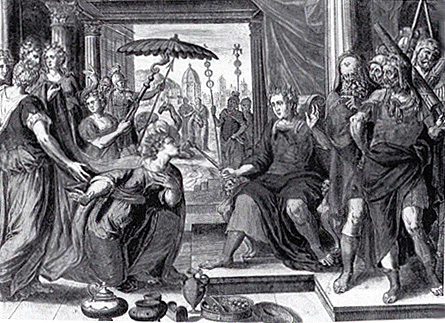
I haven’t done an exhaustive study of these representations, but a net search shows that they fall into two primary categories. The first shows the Queen of Sheba approaching Solomon from below, sometimes kneeling before him, or else ascending toward the king who is seated on a dais many steps above her.

The queen on her knees, by Gerard de Jode

Another theme appears in some of the art, however, one of parity and partnership, the true wisdom legacy of the Queen of Sheba. One of these is shown in Ghiberti’s Gates of Paradise:

Sheba and Solomon, Ghiberti’s Gates of Paradise

We’re now at a moment where women of African descent are re-envisioning who the Queen of Sheba may have really been, beyond the Jewish, Christian, and Islamic scriptural traditions, within her original cultural context. What was the reality of ancient Ethiopian women? the oldest testimony I know of is the ancient megalithic statues of southern Ethiopia, in Sidamo and Soddo, all in the form of ancestral Mothers.

Invoking woman with beaded veil, southern Ethiopia