While putting together a new visual talk on Ancient Central Europe (a very disregarded corner of history) one of the themes that emerged was lunar crescents. Clay sculptures known as Mondhörner, “moon-horns” have been found in Switzerland, dating to about 1500-900 bce, from what i’ve been able to determine so far.

Some are pure crescents, like the above, others are stands with two or three legs.
This example shows how like an animal’s horns some of them appear.
Others are more clearly crescents, or even appear shiplike:

They are often marked with symbols, line patterns, indentations and swirls.

They’ve been compared to “Cretan horns of consecration.” Some have speculated that they were firedogs (hearth supports for logs) but this utilitarian explanation does not account for the careful decoration, nor for the appearance of the clay crescents in other contexts. Here is a clearly related pot-lid from France in the same time period:

Some of these crescents are marked with chevrons and other symbols, as in the examples above, and below:
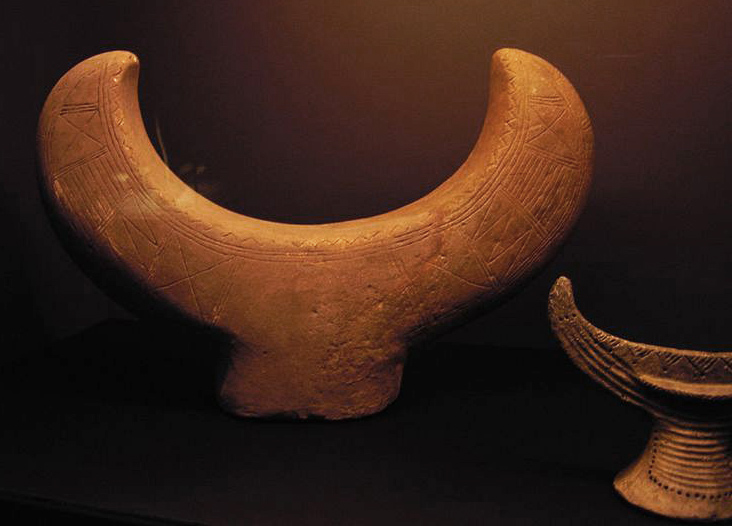
The Moonhorn at left, above, especially calls our attention because of its resemblance to another group of ancient crescents, this time in northwestern Europe. The lunulae of Ireland and Britain are incised with very similar patterns: fine zigzag borders, vertically marked-off fields filled with chevrons, and empty spaces. The one below is from an unidentified site in Ireland.
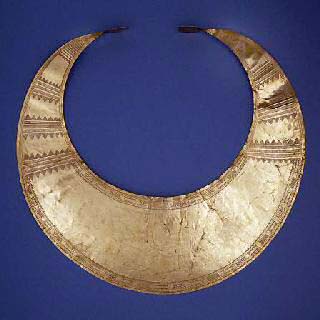
Here’s another, below, from Blessington, County Wicklow; the overexposure of the photo makes it hard to see, but it too has the chevron patterns along the “horns.” This Blessington lunula is dated to 2200 bce. (I’ve seen dates closer to 1500 for others.) They may have been produced over many centuries. Were they ritual regalia or aristocratic bling?

Some of them were found by peat-diggers in the Irish bogs.

Here’s a beautiful example from Wales. The patterns etched into the gold are so fine they are hard to see, but still the zigs and chevrons.
But what do these earlier lunulae, clearly meant to be worn, have to do with the clay Moonhorns of the continent? I don’t know, except for the evocation of the lunar crescent. But the symbolism has an even broader reach, going much further back in time on the western edge of Europe, in Portugal. Here it dates to the late neolithic, around or after 3200 bce.
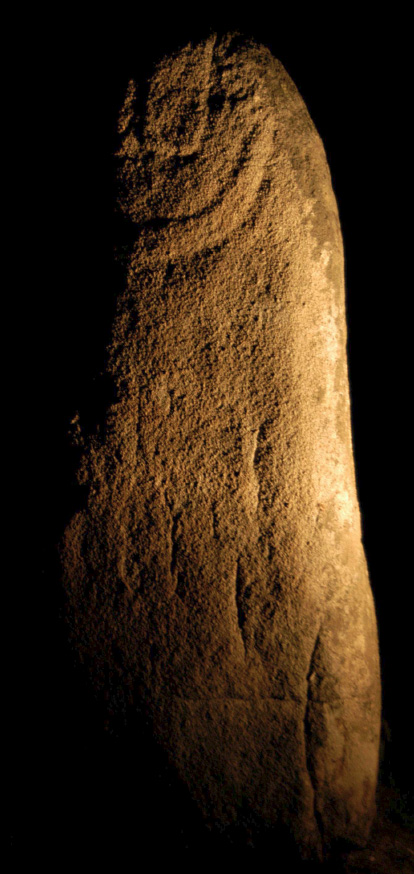
The stone circles of south-central Portugal include statue-menhirs (monoliths carved with human attributes) that are wearing lunulae on their chests. At right, one of the rough reliefs on a statue-menhir at Almendres. Two other stone circles in the same region, at Mogos and Vale Maria dos Meios, have similar statues with crescent breastplates. (The necklaces at the latter site are more deeply U-shaped than crescent, and curl up at the ends.) Some of the menhirs are breasted, others not, and often they show belts or other faint ornaments. Some of the monoliths hold crooks, or rather, because no arms are shown, these are placed against their chests. Schist crooks of the type shown have been found in Portuguese dolmens, some of them very finely incised with triangles, chevrons, and zigzags. They also appear on pottery pieces.
But it gets better. Actual examples exist of the lunulae worn by the ancient neolithic people who raised these stone circles. Excavations in the area around Lisbon have turned up limestone lunulas incised with lines similar to those on the (much younger) Moonhorns in Switzerland.

Here are drawings (no photos located yet) of the neolithic limestone lunulae of the Lisbon peninsular. This symbolism persists, or rather recurs.
In a much later period — long after the neolithic, long after the bronze age lunulae of Ireland and Britain (Scotland has at least one too), and even after the clay Moonhorns of Switzerland, metal lunulas show up in Portugal.
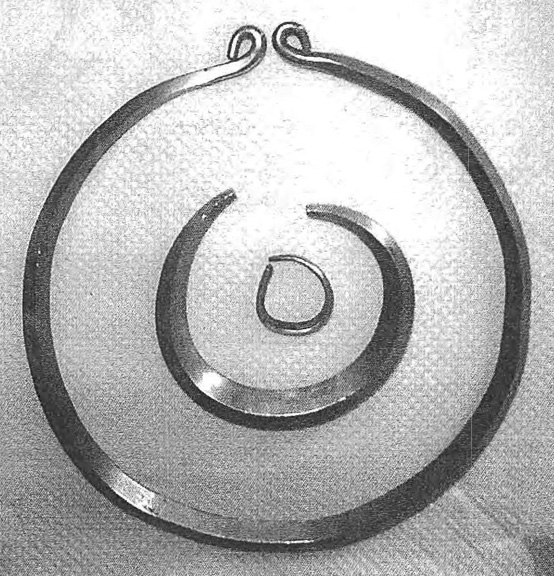
Here are several from the southern Alentejo region (no date given, possibly in the Celt-Iberian, or more appropriately, the Lusitanian era):
>
>
>
>
>
>
>>>
>>>
>>>
>>>
>>>
>>>
>>>
>>>
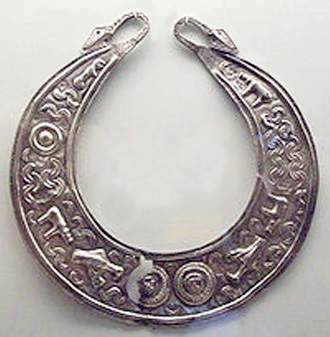
And here’s another (probably later) lunula in silver, with various symbols, animals, knotwork, and possibly breasts or eyes, and serpent torc finials. What is the story behind this lunula? This whole post is about questions, not conclusions. But the recurrence of this theme is fascinating.
Max Dashu
You must be logged in to post a comment.