
One of the obstacles in researching women is the old language of masculine default, that enshrouds women in a supposedly universal “man” or “men.” The phallacy of this becomes apparent anytime it’s necessary to differentiate between male and female: “One important difference between man and other primates is that he menstruates instead of going into heat.”
This male-default usage, which has regrettably made a comeback with the anti-feminist backlash, really gets in the way of finding the truth in historical research. It obscures what is really going on. When your source speaks only of “medicine men,” it is impossible to tell whether a given culture only recognized males, or overwhelmingly males, or whether this is the outsider’s bias, as is typically the case.
So last week I was trying to verify if the Anishinaabe (Ojibwa) medicine name wabeno, always translated as “men of dawn,” was ever applied to women, or really was exclusively male. I did not manage to get an answer to this question, but while searching ran across this story. A white guy was attending a meeting of an Ottawa medicine society in Michigan over a century ago had a run-in with an Ojibwa medicine woman:
“as Mr Cass is said to have observed an old Ojibwa medicine woman, who had come up at each dance to actively participate in the exercises, he asked someone near by why this old woman took such an active part, as she appeared rather uninteresting and had nothing to say, and apparently nothing to do except shake her snake-skin medicine bag.
“The woman heard the remark and became offended, because she was known among her own people as a very powerful mitä’kwe. In an instant she threw the dry snake-skin bag toward the offender, when the skin became a live serpent which rushed at Mr Cass and ran him out of the crowd. The snake then returned to the medicine woman, who picked it up, when it appeared again as a dry skin bag.”
Source: Walter James Hoffman 1896: 105, in Encyclopedia of Native American Healing (WW Norton, 1996 p xxxvii)
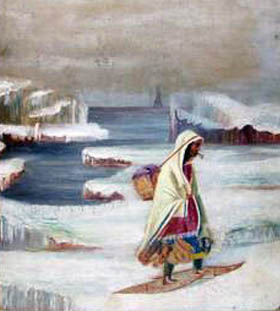
W.P. Strickland refers to a medicine woman known as the “Prophetess of Che-moi-che-goi-me-gou” or “Blue-robed Cloud Woman.” Her fasting vision quest at menarche led to a vision that conferred spiritual gifts on her. On the night of the sixth day, a voice called her to walk toward it on a narrow shining path. She saw the moon on her right and the setting sun on her left. Her account has been rendered in stiffly Victorian language, mangled even, but still beautiful:
“I beheld on my right the face of Kau-ge-gag-be-qua, or the everlasting woman, who told me her name, and said to me, ‘I give you my name, and you may give it to another. I also give you that which I have, life everlasting. I give you long life on the earth, and skill in saving life in others. Go, you are called on high.’
“I went on, and saw a man standing with a large, circular body, and rays from his head, like horns. He said, ‘Fear not, my name is Monedo Wininees, or the Little man Spirit. I give this name to your first son. It is my life. Go to the place you are called to visit.’ I followed the path till I could see that it led up to an opening in the sky, when I heard a voice, and standing still, saw the figure of a man standing near the path, whose head was surrounded with a brilliant halo, and his breast was covered with squares. He said to me: ‘Look at me, my name is O-shau-wau-e-geeghick, or the Bright Blue Sky. I am the veil that covers the opening into the sky. Stand and listen to me. Do not be afraid. I am going to endow you with gifts of life, and put you in array that you may withstand and endure.’
“Immediately I saw myself encircled with bright points which rested against me like needles, but gave me no pain, and they fell at my feet. This was repeated several times, and at each time they fell to the ground. He said, ‘wait and do not fear, till I have said and done all I am about to do.’ I then felt different instruments, first like awls, and then like nails stuck into my flesh, but neither did they give me pain, but, like the needles, fell at my feet as often as they appeared. He then said, ‘that is good,’ meaning my trial by these points. ‘You will see length of days. Advance a little further,’ said he. I did so, and stood at the commencement of the opening. ‘You have arrived,’ said he, ‘at the limit you cannot pass. I give you my name, you can give it to another. Now, return! Look around you. There is a conveyance for you. Do not be afraid to get on its back, and when you get to your lodge, you must take that which sustains the human body.’ I turned, and saw a kind of fish swimming in the air, and getting upon it as directed, was carried back with celerity, my hair floating behind me in the air. And as soon as I got back, my vision ceased.
“After the seventh day of my fast, while I was lying in my lodge, I saw a dark, round object descending from the sky like a round stone, and enter my lodge. As it came near, I saw that it had small feet and hands like a human body. It spoke to me and said, ‘I give you the gift of seeing into futurity, that you may use it for the benefit of yourself and the Indians-your relations and tribes-people.’ It then departed, but as it went away, it assumed wings, and looked to me like the red-headed woodpecker.
“The first time I exercised the prophetical art, was at the strong and repeated solicitations of my friends. It was in the winter season, and they were then encamped west of the Wisacoda, or Brule River, of Lake Superior, and between it and the plains west. There were, beside my mother’s family and relatives, a considerable number of families. They had been some time at the place, and were near starving, as they could find no game. One evening the chief of the party came into my mother’s lodge. I had lain down, and was supposed to be asleep, and he requested of my mother that she would allow me to try my skill to relieve them. My mother spoke to me, and after some conversation, she gave her consent.
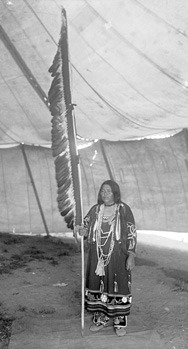
“I told them to build the Jee-suk-aun, or prophet’s lodge strong, and gave particular directions for it. I directed that it should consist of ten posts or saplings, each of a different kind of wood, which I named. When it was finished, and tightly wound with skins, the entire population of the encampment assembled around it, and I went in, taking only a small drum. I immediately knelt down, and holding my head near the ground, in a position as near as may be prostrate, began beating my drum, and reciting my songs or incantations. The lodge commenced shaking violently, by supernatural means. I knew this by the compressed current of air above, and the noise of motion. This being regarded by me, and by all without, as a proof of the presence of the spirits I consulted, I ceased beating and singing, and lay still, waiting for questions in the position I at first assumed.
“The first question put to me was in relation to the game, and where it was to be found. The response was given by the orbicular spirit, who had appeared to me. He said, ‘How short-sighted you are! If you will go in a west direction, you will find game in abundance.’ Next day the camp was broken up, and they all moved westward, the hunters, as usual, going far ahead. They had not proceeded far beyond the bounds of their former hunting circle, when they came upon tracks of moose, and that day they killed a female and two young moose, nearly full-grown. They pitched their encampment anew, and had abundance of animal food in this new position.”
These shaking-tent ceremonies were held over much of North America. The written sources I had seen until now all implied that only men performed them, but this account by Blue-robed Cloud Woman proves that women carried out these sacraments as well.
Similarly, I had never seen any reference to women carrying out the yuwipi ceremony (the medicine person is tied up and wrapped in a quilt, the bonds being loosed in short order). Not, at least, until I read Walking in the Sacred Manner: Healers, Dreamers, and Pipe Carriers-Medicine Women of the Plains Indians. (Mark St Pierre and Tilda Long Soldier,New York: Touchstone/ Simon & Schuster, 1995) which is extremely rich. I highly recommend it.
Source:
W. P. Strickland Old Mackinaw: The Fortress of the Lakes and its Surroundings. Philadelphia: James Challen & Son, 1860 http://www.gutenberg.org/files/22550/22550-h/22550-h.htm
You must be logged in to post a comment.