
The Goddess on a Lion Throne is abundantly attested in the archaeology of Lebanon, Syria, Jordan, and Canaan/Israel. First we’ll look at some Phoenician scarabs showing lion thrones, often winged. Then, actual stone thrones from ancient Lebanon, Canaanite ivories with the winged sphinxes, and an alabaster effigy of ‘Ashtart enthroned with winged lionesses. This leads to commentary on some strong biblical parallels. And we’ll look at some late hellenized forms of the Anatolian Lion-Throned Goddess.
SCARABS

Goddess offers benediction to a supplicant, under a winged sun and the planet Venus.
Many of these Phoenician scarabs show a brazier for offering incense.
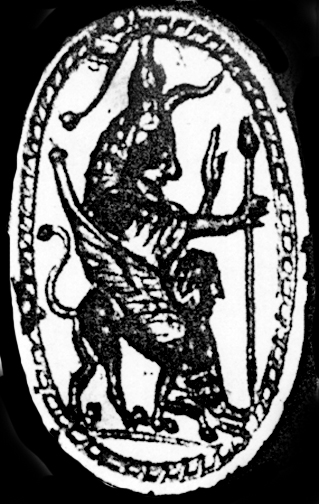
The many Phoenician finds in Sicily exhibit strong Egyptian influence. The Goddess wears the crown of Upper Egypt, with a very snaky uraeus, and holds a lotus sceptre, an attribute of Kemetic goddesses.
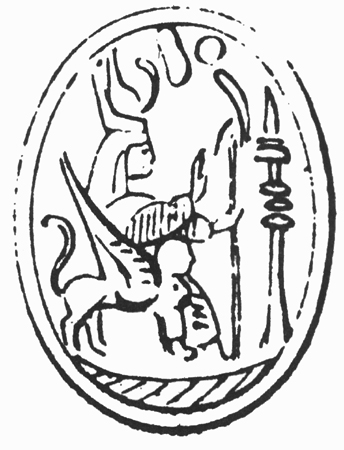 Goddess wearing the Kemetic crown of the Two Lands of Egypt
on a breasted-sphinx throne with was-sceptre and burning brazier.

Scarab from Sidon, Lebanon, with winged sun and the star of ‘Ashtart
(the planet Venus). The Goddess wears a headdress of Persian type.
THE THRONES
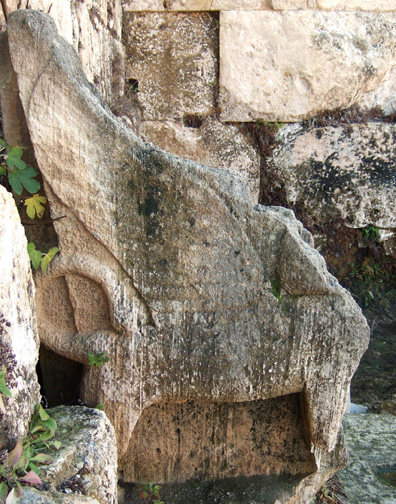
Throne of ‘Ashtart, in her Phoenician chapel inside the Eshmun temple,
Sidon, Lebanon.
The lion thrones in the scarabs depict actual thrones in Goddess temples. Besides this one, examples are known at ‘Ain Dara, near Aleppo, Syria; Dura Europos, on the Euphrates, Syria; and Khirbet et-Tannur, Jordan. Besides these, Inanna, Ishtar, and Kybele are depicted on lion thrones; while Isthtar, QDSU/Qadashah, ‘Ashtart, Asherah (in Tree form), Anahita, and the Hurrian goddess Hebat are among the goddesses shown standing on lions. (This is in no way an exhaustive list.)

Astarte Throne with Kemetic Sphinxes, Palmate Sign, and Two Betyls representing the Goddess and Her Consort. Betyls (from beth-el, house of the god) are sacred stones of a type found at Hazor nearly a millennium before. Countless earlier examples are found in the Levant and Arabia, and the Bible describes the raising of these matzeboth.

Phoenician throne with betyl and Tree of Life motif, Lebanon
This one has many similarities to the throne above, including the male sphinxes and
the Tree sign. See more examples of this association in the ivories below.

A stone throne from Beth Shean in the West Bank, undated,
but much older than the foregoing examples.
THE IVORIES
Goddess thrones with lions or sphinxes have direct parallels in Canaanite ivories:

The winged sphinxes also appear in ivory furniture ornaments of Canaanite and early Hebrew palaces. She appears to hold a Double Feather crown of Egypt. Note her multiple lioness breasts.

This winged female sphinx may come from Ahab’s Palace of the Ivories; if so, this is where Jezebel lived. The princess of Tyre was renowned for bringing with her to Israel (she married Ahab) 400 priests of Baal and Asherah. Were there priestesses in this group? Hebrew, like Romance languages, uses the masculine default, and so the male plural obscures the presence of women in any group that includes a single male.

This beautiful ivory shows the strong Egyptian gravitational field upon Canaan.
Egypt ruled the country for centuries, and artifacts from Canaanite temples are drenched
with Kemetic symbols and style. Horus sits upon a lotus, flanked by masculine winged beings
whose prototypes are Auset and Nebthet (Isis and Nepthys), long shown as winged protectors
in Kemetic art. Several Nimrud ivories, and earlier ones of Hazael of Damascus, show winged women.

The same motif on an ivory from Nimrud, Iraq, crafted by a Canaanite artist in Assyria. In the center would have been a sacred lotus-palm (like those on the Phoenician thrones above), of which only a bud and some volutes are now visible. (The pig-snout-like roundel at center would have held pegs that attached a palmate sign to the carving.)

The winged beings here flank the Tree of Life, a Goddess form. This is not speculation
(see next image, and recall the exampless from the thrones of ‘Ashtart above).
Further south, early Israelite iconography shows the goddess Asherah as this palmate Tree,
flanked by ibexes, and standing on a lion, just like Ishtar and Ashtart and Hebat.
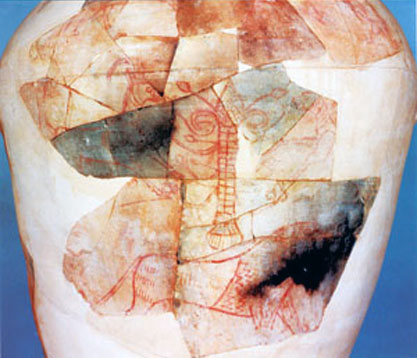
The pithos from Kuntillet ‘Ajrud with the celebrated inscription
of “Yah of Teman and his Asherah.”
This discovery in the Sinai, along with another Asherah inscription at Khirbet el-Qom, finally broke through the long doctrinal insistence on Hebrew monotheism in the early kingdom period. The image combined with the inscription naming this goddess is quite powerful. Some scholars contend that the Asheratw of the inscription, and the asheroth/asherim of the Bible, allude only to a ritual pillar, not to the goddess. But since the pillar is named for the goddess and various prophets inveighed against both, this minimalist interpretation has little to recommend it, except to uphold the dogma that the Hebrews had nothing to do with any Goddess. And this claim conflicts with the testimony of Kings and Chronicles.
The archaeological record, too, shows overlap of Goddess/Tree flanked by rampant ibexes or goats. And more: the Lachish Ewer, found in a Canaanite temple circa 1500 bce, places a vulva in this central position. A goblet from the same sanctuary ties it all together even more dramatically with a menorah between the horned animals, and clinches the Goddess connection with an inscription that labels the goblet “an offering poured out to Elat.” As Joanna Stuckey points out, “the word for goddess, Elat, is positioned right over one of the stylized trees.” [See link above for more.] Descriptions of menorahs in the Bible leave no room for doubt that they represent the sacred Tree.
THE CHERUBIM AND THE MERCY SEAT
Now let’s look at this from another angle that relates directly to the Lion-Throned Goddess. We’ve seen goddesses depicted on the lion- or sphinx-flanked thrones; also represented by betyls on those thrones, and some empty thrones where the divine Presence is not depicted iconically. This last became the primary direction developed in monotheism, with its insistence on no direct representations of deity, now being understood in near-exclusively masculine terms. (There are a few references in the Hebrew Bible to godly motherhood.) Still, monotheism developed against a cultural background of preponderant Goddess iconography, and retained the archaic lion- or sphinx-throne. There are also some images of kings seated on such thrones: a stone relief of Ahiram and an incised ivory of an unnamed Canaanite ruler at Megiddo. But no gods on lion-thrones, only on thrones flanked by bulls, as discussed in previous posts.)
The Torah, however, continues to present the lion-throne as a divine seat, flanked by the cherubim. It describes them as winged guardians of the Holy of Holies in the desert Tabernacle of the ancient Hebrews:
And you shall make two cherubim of gold; of hammered work shall you make them, on the two ends of the mercy seat. Make one cherub on the one end, and one cherub on the other end; of one piece with the mercy seat shall you make the cherubim on its two ends. The cherubim shall spread out their wings above, overshadowing the mercy seat with their wings, their faces one to another; toward the mercy seat shall the faces of the cherubim be. And you shall put the mercy seat on top of the ark; and in the ark you shall put the testimony that I shall give you. [Exodus 25:18-21 (RSV)]
YHWH spoke from the space between these cherubim on the ark cover. This “mercy seat” was one and a half cubits wide (2.25 feet), the size of a throne seat. An additional ten cherubim figured on the Tabernacle’s curtains, and another on its inner Veil, making a total of twelve. [70]
Raphael Patai called attention to the feminine associations of the divine Presence in the Tabernacle in The Hebrew Goddess. It was described as a cloud hovering and filling the tent, “which at night glowed like fire.” He tells us that “the desert Sanctuary was called Tabernacle (Hebrew, mishkan: literally, ‘dwelling place’), because of the divine cloud that abode (shakhan) over it and in it.” [Patai, 73-4] These words come from the same root as Shekhinah, a word that became current as a name for the indwelling divine Essence in the Exile period. Along with Khochmah in Genesis and Proverbs, Shekhinah became a primary way of understanding the female aspect of divinity in Judaism.
In the Temple of Solomon, two gigantic cherubim stood over the ark. They were carved from olive wood and plated with gold, and were fifteen feet high, with a combined wing-span of thirty feet. The walls were covered with graven cherubim, palm trees and open flowers in gold. (I Kings 6:23-35). Before the destruction of the Second Temple in Jerusalem, Philo described the two Cherubim, who represent the hemispheres of heaven, with their wings “inclining to the mercy seat.” [Patai 76]
Cherubim was the plural of kerūv in Hebrew:ּרוּב, ּרוּבִים, which was latinized as cherubim. It had a special dual form kərūvāyim (a common form in Semitic, but as we’ve seen, these beings typically appeared in pairs). Hebrew keruv has cognates in other Semitic languages: Assyrian karabu, Akkadian kuribu, and Babylonian karabu. The Assyrian name means “great, mighty,” but the Akkadian and Babylonian forms mean “propitious, blessed”. They saw these beings as guardians of the Sacred. In Genesis, cherubim stood with revolving swords of flame at the East of Eden, “to keep the way of the tree of life.” [Gen. 3:24] So when I look at the ‘Ashtart of Galera, I see her, the female Divine in all her Glory, between the same winged guardians:

The ‘Ashtart of Galera, Granada, was placed in a Spanish burial circa 450 bce
but produced by Syrian or Lebanese artists near 200 years earlier. She is an alabaster vessel
designed for libation rituals; the liquid poured in through her head flowed out from her breasts
into the basin she holds. Some speculate that wax was placed in her nipples,
and the image heated, causing the liquid to suddenly pour forth.
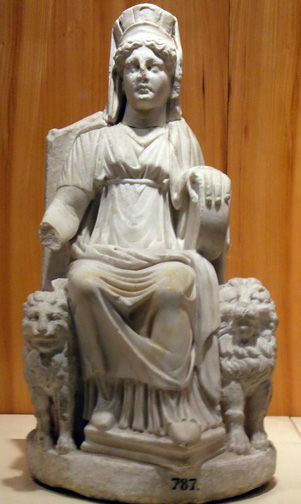
A hellenistic Kybele from Ashdod, with her drum and
a mural crown borrowed from the Syrian goddess Tyche.

Kybele on a Roman coin, title Mater Deum, “Mother of the Gods.
She sits on the lion throne with sceptre and mural crown.
There are many more examples of this far-reaching pattern: the goddess shown between lions on the clay altar from Taanach; the lions of the famous Ishtar Gate in Babylon, and the many cylinder seals showing her standing or sitting on lions; the coins showing Atargatis of Hierapolis, Syria, and Juno Caelestis of Tunisia, riding on lions’ backs. I’m told that coins from Salamis, Cyprus, show Aphrodite standing on a lion or seated on a lion throne, in the 4th century bce.
Older than all of these are the lion-headed goddesses of Africa, most famously Sekhmet, in her profusion of monumental black basalt statues, and later the lion-faced goddess of Carthage, Tunisia. Older still is the Goddess of the Leopard Throne at Catal Höyük, circa 6000 bce. See my earlier photo essay on Cultural Continuites (with forms from Anatolia, Greece, Bulgaria, Lebanon, Rome, Spain, and Afghanistan) and my preceding articles on Goddess Temples in Western Asia, on this blog.
Max Dashu
You must be logged in to post a comment.