Continuing my photo essay and review of Kristina Michelle Wimber’s article
“Four Greco-Roman Temples of Fertility Goddesses: An Analysis of Architectural Tradition,” 2007.
Atargatis
Wimber compares the temples of Atargatis at Hierapolis and Dura Europos, Syria, with another on the Aegean island Delos, a Jordanian goddess temple at Khirbet et-Tannur, and the Derketo temple at Ashkelon. She remarks

on the highly syncretic nature of this goddess, who blends old Iraqi themes with Syro-Palestinian and Hittite influences. [34] I would add that pillar goddess iconography from western Anatolia became especially influential. Atargatis is often shown in this form, closely resembling the statues of Upis/Artemis Ephesia, Hera of Samos, and others, on coins and in sculpture.
The best testimony about the Atargatis temple at Hierapolis comes from De Dea Syria, written by the Romano-Syrian Lucian of Samosata in the 2nd century ce. He says that Stratonice, wife of one of the Seleucid kings, had the temple built around 300 bce. (Legend claimed that the architect performed a self-castration to protect himself from accusations that might arise from showing his royal patroness around the construction site.) The great temple of Hierapolis stood on a hill surrounded by walls and was entered through a colossal stone portal with two tall columns beside it. [39-41] In front was a sacred lake with consecrated fish.

In the usual Hellenistic fashion, Lucian interpreted the goddess through the lens of Hera, Aphrodite and Athena. The fact is that Atargatis did not really fit any Greek template. She was thoroughly Asiatic. (Wimber remarks, “In De Dea Syria Lucian can not even decide which deity Atargatis represents…”) [114] The divine image of Atargatis showed her seated on a lion throne next to her consort Hadad on a throne of bulls. Lucian wrote:
The sanctuary faces the sunrise…Within, the temple is not all of a piece, but contains another chamber. It too has a low staircase: it has no doors and is entirely open to the onlooker…In it are enthroned the cult statues, Hera [Atargatis] and the god, Zeus, who they call by a different name [Baal-Hadad]. Both are golden, both seated, though Hera is borne on lions, the other sits on bulls. [78]
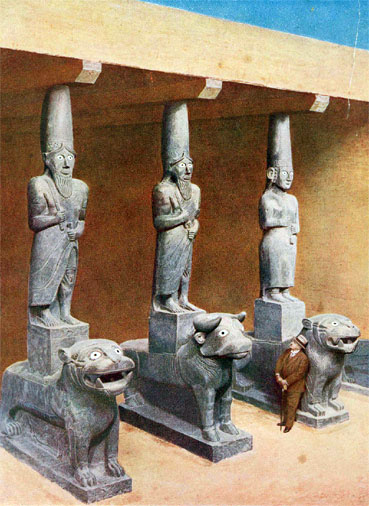
This pairing is repeated at the sanctuaries of Dura Europos on the upper Euphrates and at Khirbet et-Tannur in Jordan. It relates to older temple iconography at ‘Ain Dara, which features the same goddess/lion and god/bull thrones, and at Tell Halaf, where Hebat stands on a lion and two gods on bulls.
Hierapolis (the “holy city”) was originally known as Manbug, from the Semitic root nb’ meaning “to come out”. The name is interpreted as a pouring forth of water from the rock. Devotees came to pour libations down a crevice in the rock under the temple, said to be the place where the Great Flood was swallowed up. This hilltop rock chasm points to a much older sanctuary that must have pre-existed long before the Seleucid temple was built. [39, 43] Its water ceremonies continued, with processions carrying the image of Atargatis to her sacred lake to be immersed, while others brought ocean water to the temple. [57]
The temple of Derketo at Ashkelon also had such a lake. The Greek physician Ctesias wrote down a story of how she turned into a fish after she leapt into the sacred pool. Lucian related that people here revered Atargatis as half woman, half fish, which is why they would never eat fish. He also refers to rites in which the statues of Atargatis and Hadad were carried to the lake to see the sacred fish. The name Derketo is a contraction of Atargatis. Little remains of her once-great temple now, of the organized demolitions under the Christianized emperors of late antiquity. (The coastal Palestinians resisted these temple destructions with determination, as Ramsey MacMullen documents, and even afterward refused to walk on the roads built with their stones.) But not all of the destruction happened then. Wimber turned up a traveler’s account of seeing a sculpture of a naked woman surrounded by fishtailed figures in the ruins of Ashkelon as late as 1697. [104]
Veneration of Atargatis spread throughout the Syrian diaspora, to the island of Delos, where Syrian merchants built a temple to the goddess in the 2nd century bce. It was laid out in the West Asian style, and had ties to the priesthood of Hierapolis. Other Syrians arrived on Delos, a major depot of the slave trade, as Roman captives to be sold. Large numbers of these enslaved Syrians were shipped off to the Roman plantations on Sicily. There they raised two powerful insurrections in the name of Dea Syria, led by prophets of Atargatis.

Coins from Hierapolis show Atargatis with lions. A relief from her temple at Dura Europos on the upper Euphrates shows her on a lion throne, with her consort Hadad beside her on a bull throne. Wimber comments, “This arrangement strongly parallels the cult statue at Hierapolis as described by Lucian—as does the lions flanking the throne at Delos.” [48] She goes on to draw other parallels:
One of the most important elements of Lucian’s account which the relief of Hadad and Atargatis found at Dura Europos corroborates is the standard with circles on it surmounted by a dove placed between the deities. It is called the semeion by Lucian and interpreted to be a symbol of the Babylonian queen Semiramis (c. 800 BC) who supposedly founded the temple in another of Lucian’s foundation myths. An interesting aspect of the cult revealed by the Dura relief is that Atargatis was apparently more important that Hadad because she is depicted as larger than Hadad and he appears pushed to the side and behind her. This belief is underscored by the inscriptions at Delos which mention Atargatis more often than her consort. [49]
Wimber also refers to “the relative importance of Asherah over Baal” in earlier Canaanite settings. However, I question her statement that “By the time of Lucian’s writings, Atargatis had lost many of the attributes of Ishtar including her blatantly aggressive sexuality and warlike character.” [38] We can not assume that these goddesses were identical, even though their names have a shared etymology. The first element in Atargatis is ‘Atar, an Aramaic 
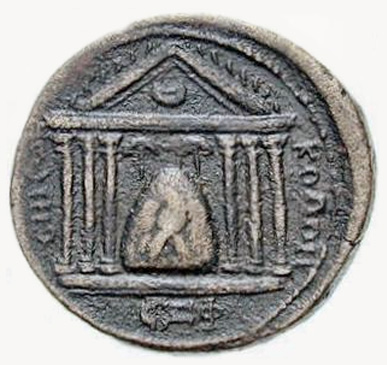
meaning remains unclear.) The name first turns up in the Annals of Ashurbanipal as Atar-Samain (Venus of the Heavens).
The linguistic constellation does reflect the co-gendered nature of Mesopotamian Ishtar, in the sense that some forms are female, such as Ashtart and Atargatis, while others are masculine: Yemenite ‘Athtar, Moabite ‘Ashtar, and Ethiopian ‘Astar. Even Ishtar is grammatically masculine in Akkadian, with the feminine form Ishtartu used in special contexts. In several places, these related deities were represented by betyls or standing stones. Ashtart-Aphrodite was revered at Paphos in the form of somewhat triangular pillars, for which precedents are found on the mainland, from Hazor to Arabia.
Nabataea: ancient Jordan and north Arabia
The old Nabataean tradition was veneration of betyl stone and niches cut into the rock. [50] This corresponds with two major Semitic traditions, the Hebrews of Jacob’s time, who raised matzeboth, and the Arabians up to the time of Muhammad, whose goddesses resided in standing stones. Their Phoenician cousins practiced this too; a marble pillar at Kition, Cyprus, was inscribed as a massebah to Astarte’s consort Eshmun. [90] Wimber says the Nabataeans spoke Aramaic (or at least their inscriptions were in that language, but that does not prove much, since Aramaic was the chancery language across west Asia in the last millennium bce).

The Nabataeans at Petra added Hellenistic sculptural icons, but in their own completely unique style, to the older aniconic stones. Al-Uzza, the goddess who represented the planet Venus and so corresponded to Ishtar /Ashtart /Inanna, appeared both as betyl and sculpture. Like Allat and Dushares, she was syncretized with the dominant Greco-Roman deities and sometimes called by their names. The influence of Atargatis is seen in the form of her sacred fish, which crown al-Uzza in a temple relief at nearby Khirbet et-Tannur. [50-1] Sea goddesses with fish are depicted in several Jordanian mosaics, with Greek inscriptions naming Tethys or Thalassa.
Although it can be difficult to find much about the goddesses of Petra—scholarly writings often concentrate on the god Dushares—Wimber fleshes out the picture considerably:
Al-Uzza was most likely the consort of Dushares while Allat was his mother, and perhaps the mother of all the gods. In certain cases Al-Uzza seems to have outstripped the importance of Dushares to the Nabataeans as she is often depicted as the larger of two betyls. Atargatis was not a

native Nabataean goddess and one inscription under an eye idol in the Wadi es-Siyyagh near Petra reveals that she was numbered among the foreign deities worshipped by the Nabataeans. … Nabataean religion remains a mystery and even the most notable scholars in the field cannot decide who exactly was worshipped where and what the attributes belong to which deities. [52]
While the original names are uncertain, Wimber concludes that the Nabataeans at Petra venerated al-Uzza, Allat, and Aphrodite in the Temple of the Winged Lions and, paired with a male consort, at Qasr al-Bint Pharaon (an Arab name that means “castle of Pharaoh’s daughter”). [75-6] I agree that the original deity names would have been Arabian, not Aramaean. Wimber compares the betyl-goddesses of Petra to the stone pillars of the old Hijazi goddesses, and cites Ibn al-Kalbi’s account of chopping down three trees in the sanctuary of Al-Uzza, and beheading the goddess on the orders of Muhammad. [92]
Khirbet et- Tannur
The temple of Al-Uzza here was built in the 2nd century bce, high on the hill Jebel Tannur and far from any city. [53] The temple faced east. It began as a sculptured altar, which kept growing larger, eventually reaching a height of over 10 feet. Old offerings were incorporated inside its new stone facings. The (Syrian fate goddess) Tyche, Hadad and Helios were carved in relief above the Corinthian and horned Nabataean columns, which were combined with Egyptian cornices. The inner shrine was entered through a portal surmounted by an semicircular stone panel of the goddess. She is crowned with a tall polos headdress with an eagle, yet her hair is unbound, flowing freely around her face. Flowers, fruits, and greenery course around her and adorn her neck, chest, and even spill onto her forehead.

The Goddess statue of the inner sanctum was later demolished with prejudice; only one foot, a lion and a bit of her throne survived. The destroyers apparently considered her consort less threatening, since they spared his statue. This special hostility seems to have been prompted by misogyny, since here as elsewhere, the goddess was the more prominent figurine of the pair, as the author comments: “Al-Uzza’s prominence at Khirbet et-Tannur is demonstrated by her many manifestations and demonstrates her preeminence over her consort Hadad.” [54-6]
Here is a good summary of Wimber’s thesis:
The key element which ties all the temples at Delos, Dura Europos, Khirbet et- Tannur, and most likely Hierapolis, is their use of the open-court Mesopotamian plan. The Mesopotamian plan, as used in temples of Near Eastern fertility goddesses, has at least a 3,000 year history from Eanna in Uruk, c. 3,300 BC, to the temple of Eshmun at Sidon, c. 400 BC. The choice of this type of plan by fertility goddess worshippers in the Greco-Roman period is significant. The Mesopotamian temple plans stand as testimonies to the power of tradition in the Near East and as grounds to reinterpret past scholarly research which ignores the great amount of tradition which remains in the temples alone, let alone the cults as a whole. [63-4]
The far-reaching influence of these temples extended as far as Afghanistan, where it is reflected in two temples at Ai Khanoum, circa 300 bce. Wimber also remarks on the remodelings that the Mesopotamian temples underwent across three millennia, and the impressive staying power of the ceremonies that they housed: “The continuing power the cults practiced in Uruk even into Hellenistic times is evidenced by the rebuilding of many of the temples and the continuation of cult functions in Uruk.” [65-6]

Kristina Michelle Wimber observes that the great temples at Baalbek, Lebanon, look Greco-Roman, but points out that the deities “were basically Near Eastern Deities with added Roman names such as Jupiter-Baal, Venus-Astarte and Bacchus-Dionysus.” The tower in the Baal sanctuary, too, was purely Asiatic. [62-63] Wimber adds, “It has also been proposed that the Aeolic and Ionic columns derived from the volutes of the gate-post symbol of Inanna and thus the feminine nature usually associated with the Ionic column comes from this symbolism.” [81] So we come around again to the pre-imperial earth-sanctuaries of the Sumerian goddess.
I remember feeling disappointed, long ago, seeing the Greco-Roman appearance of Asian temples from this period, but the history shows that this influence is in fact a backwash. Over time I realized that the Greeks had derived much of their temple architecture from Asiatic styles, particularly the Canaanite voluted column which inspired Aeolic and then the Ionic column (itself named for a coastal region of Asia Minor).
The Canaanite style in turn owed much to the Kemetic lotus-pillars of ancient Egypt. The Doric column, as well, did not originate in Greece, but first appears in a funerary temple at Sakkara in the 3rd millennium bce, nearly two thousand years before the first columned temples of “Greek” type—which appeared on Samos, off the coast of Asia Minor, not in Hellas. The Corinthian column originated in a city so famous for its Phoenician and Asiatic influences that Greek

classicists regard it as ground zero for “orientalizing” (that word again), meaning that they copied from those cultures. If we look back to those Canaanite societies, they themselves had earlier become deeply impressed with Kemetic influences, to the degree that statues of Baalat and other old Lebanese goddesses look like Isis. Hieroglyphics are found on seals, the omnipresent sphinxes themselves are modeled after Kemetic prototypes, the faces are stylistically Egyptian, and Hathor appears again and again as Ashtart.
Max Dashu
This is a quick whisk through a huge subject, or rather several subjects, but all I have time for right now. I’ve stayed with the outlines laid out in Wimber’s article, without going into large and important related areas: the Phoenicians, Carthaginians, and their spread of these cultural memes across the Mediterranean; the massive Anatolian heritages that predate and surround the Hurrian and Hittite and Ionian cultures; the rich literature of invocations to Inanna and Ishtar, starting with the priestess Enheduanna, the first author whose name is recorded; the story of the priestesses themselves, and how male priests gradually pushed them out of leadership positons and even the priesthood itself over a long span of time; and the related issue of the temples under empire, and utilization of religion to legitimize and shore up rulers. African influence on the Canaanites (whose languages, remember, belong to the Afro-Asiatic family) and for that matter, the Greeks, is another important area that I will go into more in future.
Sources cited:
Kristina Michelle Wimber, “Four Greco-Roman Temples of Fertility Goddesses: An Analysis of Architectural Tradition.” Thesis at Brigham Young University, 2007
Joanna Stuckey. “Shaushka and ‘Ain Dara: A Goddess and Her Temple”
http://www.matrifocus.com/IMB08/spotlight.htm
Gary Beckman, “Ishtar of Nineveh Reconsidered.” University of Michigan
(Thanks to Yona Yavana for this source.)
You must be logged in to post a comment.